
a16z: 5 Key Metrics to Understand Crypto Industry Development


Original Article Title: 5 metrics to watch in 2025
Original Article Author: Daren Matsuoka, a16z crypto Partner
Original Article Translation: Luffy, Foresight News
2024 was an exciting year in the history of the crypto industry. Cryptocurrency activity and usage reached an all-time high, blockchain infrastructure saw significant improvements, transaction fees decreased, stablecoins found product-market fit, the intersection of cryptocurrency and artificial intelligence became clearer, Bitcoin and Ethereum ETFs were approved, and the legislative and regulatory environment has now paved a positive path for the crypto industry. All of this sets the stage for another exciting year.
When considering the next steps for cryptocurrency, here are five metrics we will be closely watching to track the industry's continued progress.
Monthly Mobile Wallet Users
To kickstart the next wave of cryptocurrency user growth, we need to make the user experience more akin to Web2 applications. Mobile wallets will play a key role: there are billions of "passive" cryptocurrency holders (those who own cryptocurrency but do not regularly engage in on-chain transactions) who could be converted into active users. To achieve this, developers need to continue building new consumer applications, and consumers need wallets to participate.
Last month, the number of mobile wallet users reached a historical high, surpassing 35 million for the first time. This growth was driven by the increasing user numbers of popular wallets like Coinbase Wallet, MetaMask, and Trust Wallet, as well as the momentum from some new entrants like Phantom and World App.
For developers, consumer wallets pose some of the industry's most challenging issues, as finding the right balance between security, privacy, and usability is not easy. But now that blockchain infrastructure is capable of supporting hundreds of millions, if not billions, of people conducting on-chain operations, it is the perfect time to build the next generation of mobile wallets. In 2025, we will closely monitor these development trends.
You can track the monthly mobile wallet users here.
Adjusted Stablecoin Transaction Volume
As infrastructure has improved significantly, reducing transaction costs, stablecoin activity saw an increase in 2024. It's worth noting that stablecoins are used not only for cryptocurrency trading but also for cross-border payments and remittances, purchasing goods and services, and as a store of value in countries experiencing high inflation. Stablecoins have become the lowest-cost method of transferring dollars, and we expect more and more businesses to accept stablecoin payments.
Fueled by these favorable factors, blockchain-based value settlement should continue to grow in 2025. While we can easily measure this transaction volume using on-chain data, separating out the true usage of stablecoins is challenging. Transactions can be initiated either manually by end users or automatically by programmatic bots, and some on-chain transactions may not resemble traditional settlement methods.
Fortunately, Visa has created a clear and simple method that can both demonstrate the usage of stablecoins and eliminate the impact of non-organic activities caused by bots and other artificial inflation behaviors.
If stablecoin adoption—the most clear-cut use case for cryptocurrencies—takes off in 2025, this metric will be closely watched.
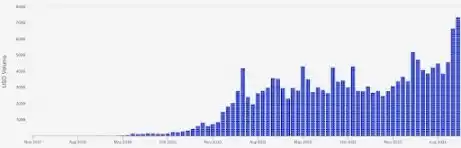
You can track stablecoin transaction volume here.
ETF Net Fund Flows
Last year, the U.S. Securities and Exchange Commission approved Bitcoin and Ethereum ETFs. This was a significant milestone that made it easier for retail and institutional investors to access cryptocurrency. However, activating distributors such as Goldman Sachs, JPMorgan Chase, and Bank of America to incorporate these products into institutional investor portfolios will take time.
One way to measure ETF activity is through "net fund flows," which represent the inflow or outflow of Bitcoin or Ethereum from ETFs. (Excluding products that previously existed, such as the Grayscale Bitcoin Trust and Ethereum Trust, which ultimately converted to ETFs.) So far, Bitcoin ETFs have seen a net inflow of 515,000 coins, while Ethereum ETFs have seen a net inflow of 611,000 coins.
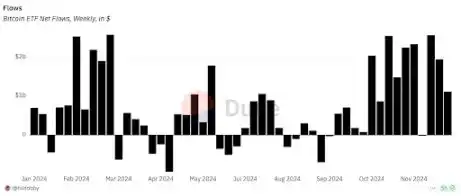
As more institutional investors seek to enter the cryptocurrency space, ETF net fund flows are expected to increase. By tracking on-chain deposits and withdrawals at addresses confirmed to be ETF custodians, we can monitor this data in real-time.
You can track ETF fund net inflows here and here.
Decentralized Exchange vs. Centralized Exchange Spot Trading Volume Comparison
As users flock to the blockchain space, we expect decentralized exchanges (DEXs) to see an increase in usage relative to centralized exchanges (CEXs) in cryptocurrency trading. After all, decentralization is at the core of cryptocurrency's value proposition in decentralized finance (DeFi). With the development of the DeFi ecosystem, the spot trading market share of DEXs has steadily grown to around 11% in recent years, and we expect this trend to continue into 2025.
Recently, with new users entering the space, trading volumes on chains like Coinbase's Base Chain and high-throughput chains like Solana have surged, driving DEX trading volumes to new highs.
With more new consumer applications coming online, DEX trading volumes may further increase.
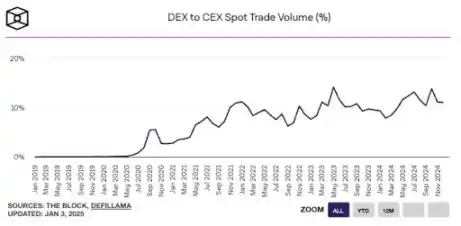
Monitoring the balance shift between decentralized native crypto activities and centralized crypto trading will be a key metric to watch.
You can track the spot trading volume comparison between DEX and CEX here.
Blockchain Total Transaction Fees
Total transaction fees (measured in USD) display the overall demand for block space on a specific blockchain, indicating real economic value.
However, this metric has its nuances as most projects are explicitly working to lower costs for users. This is why considering the unit transaction cost (i.e., the cost of a specific amount of blockchain resources) is also crucial. Ideally, overall demand (total transaction fees) increases while Gas fees (cost per unit of resource usage) remain low.
In November 2024, Solana's fees surpassed Ethereum's for the first time ever (see graph below). It is worth noting that this milestone occurred even though Solana's per transaction cost is much lower; sending a US dollar stablecoin (USDC) on Ethereum costs approximately $5, while on Solana, it is less than 1 cent. This is a significant milestone, and we will continue to monitor this development.
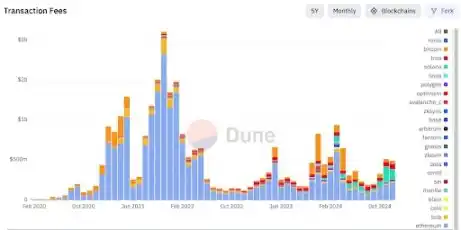
Many ecosystems and their related fee markets are maturing, making it a good time to begin measuring the economic value facilitated by various blockchains. In the long run, the demand for block space (measured in total fee dollar value paid) may be the single most important metric to track the progress of the crypto industry. Why? It reflects the level of participation in economically valuable activities and the willingness of users to pay for them.
You can track the demand for block space through transaction fees here.
Summary
We have tracked various metrics of the crypto industry, but this year we will closely monitor these five metrics. With widening investor access channels, mature infrastructure paving the way for new applications, and more popular products (such as stablecoins) emerging, the crypto industry is well-positioned to attract more users and developers. Let's see what new developments will emerge this year to ultimately drive changes in these metrics.
You may also like

Cursor, why did you get on Musk's spaceship?

Morning Report | DeepSeek completes over $7 billion in financing, with a valuation exceeding $50 billion; Musk's personal wealth has surpassed the total market value of Bitcoin

SharpLink CEO: How to understand that Ethereum developers have just surpassed 1 million?

Morning Report | MiCA grace period expires on July 1; Kalshi's trading volume in the first week of the World Cup breaks $5.1 billion, setting a record

The foundation of SpaceX's trillion-dollar valuation: Who is dividing Musk's annual capital expenditure of tens of billions?

How to exit after asset tokenization?

The stablecoin positioning battle escalates: When compliance is just a ticket to entry, will USD1 become the biggest winner?

A16Z: The sun bears witness, SpaceX is worth 7.5 trillion
Mergers and acquisitions in the cryptocurrency market are exceptionally active

Concerns Behind the Binance Customer Service Controversy

SpaceX Stock Prediction After the IPO: Can SPCX Reach $200 Before QQQ Inclusion?

Congratulations to Carl Moon on His Historic Ferrari Challenge Le Mans Podium Triumph
Crypto influencer and racing enthusiast Carl Moon finished third in the Ferrari Challenge Le Mans Coppa Shell class, marking his best result of the year. As his racing partner and sponsor, WEEX celebrates this remarkable achievement and continues to lead crypto’s journey beyond boundaries, uniting the innovation of digital assets with the passion of motorsport.
Can the CLARITY Act Become Law by July 4? Everything You Need to Know About the Final Battle

France vs Senegal World Cup 2026: Mbappe’s New Era Begins Against a Historic Rival
What is the connection between Huang Zheng of Pinduoduo and blockchain?

Morning Report | Prediction market platforms like Kalshi and Polymarket jointly sue Kentucky over 14.25% trading tax; Bridgewater founder discusses decision-making in the AI era: principled thinking should run parallel to AI, human insight remains irre...

If the AI bubble has already burst, who will truly remain?

Paul Graham: How to Make a Billion Dollars
Cursor, why did you get on Musk's spaceship?
Morning Report | DeepSeek completes over $7 billion in financing, with a valuation exceeding $50 billion; Musk's personal wealth has surpassed the total market value of Bitcoin
SharpLink CEO: How to understand that Ethereum developers have just surpassed 1 million?
Morning Report | MiCA grace period expires on July 1; Kalshi's trading volume in the first week of the World Cup breaks $5.1 billion, setting a record
The foundation of SpaceX's trillion-dollar valuation: Who is dividing Musk's annual capital expenditure of tens of billions?
How to exit after asset tokenization?


