
- Buy Crypto
- Markets
 Futures
- Spot
- Copy Trade
- Earn
- More
After Iran's Political Risk Rises, Cryptocurrency Sees Massive Outflow

Original Article Title: "After Bombing, Iranians Frantically Move Crypto Assets Out"
Original Article Author: angelilu, Foresight News
On February 28, 2026, the United States and Israel jointly launched the first airstrike on Iran. Within minutes of the news breaking, assets on Iran's largest cryptocurrency exchange platform, Nobitex, began flowing out at an abnormal pace. Meanwhile, on the other end of the Middle East, after days of war, the Tel Aviv Stock Exchange closed at a record high on March 2.
Same war, two drastically different financial signals: one side celebrating capital, the other side witnessing wealth flight. This scene may be the best glimpse into the true role of cryptocurrency assets in geopolitical conflicts.
Nobitex Outflow Surges by 700%
Nobitex is Iran's largest cryptocurrency exchange platform, with over 11 million registered users. In 2025, it processed a total cryptocurrency trading volume of $7.2 billion, serving as a core infrastructure of Iran's crypto ecosystem.
According to blockchain compliance firm Elliptic's on-chain monitoring data, immediately after the US-Israel airstrike, Nobitex saw a 700% surge in cryptocurrency outflows. The flow of funds indicates that these assets are being moved abroad, primarily to overseas cryptocurrency exchanges that have historically received a significant amount of Iranian funds.
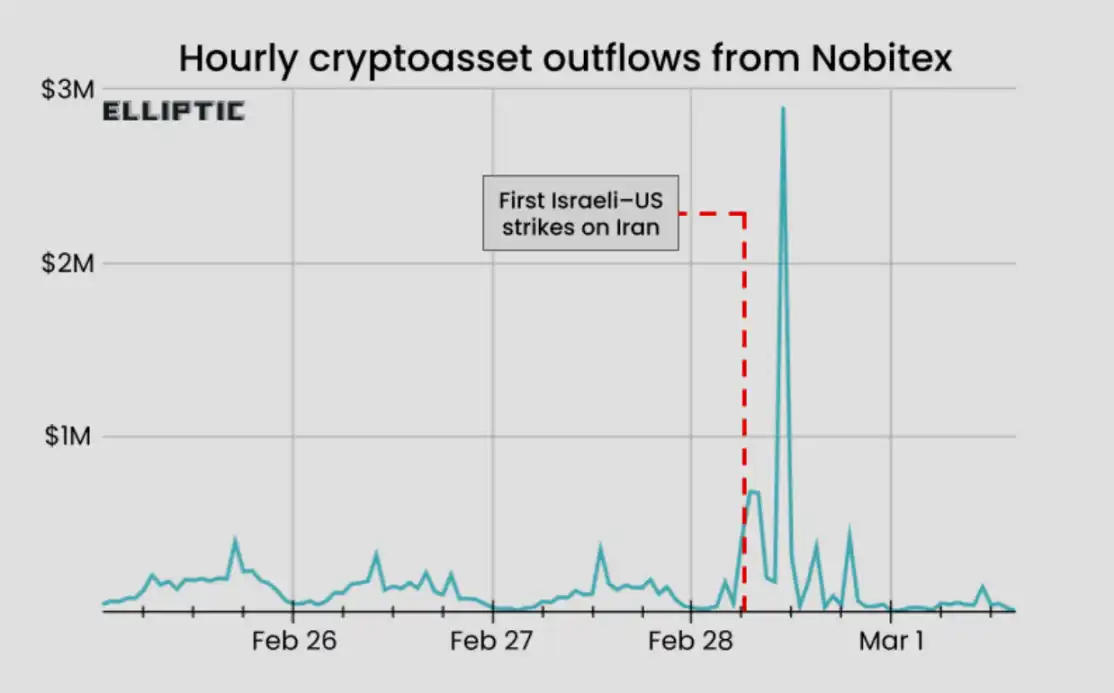
Subsequently, shortly after the US announced sanctions on Iran, cryptocurrency experienced two minor spikes again, indicating that cryptocurrency may be used to try to circumvent these sanctions.
A detailed analysis of the chart data reveals that the baseline of normal outflows from Nobitex before the airstrike was roughly $300-400,000 per hour. The peak outflow of cryptocurrency was about $2.8 million per hour. While the absolute amount is not very large, it reflects a behavioral signal: as soon as the news broke, people's immediate reaction was to move their assets. Furthermore, what Elliptic monitors is only the traceable part on-chain. A large number of Iran's cryptocurrency transactions are conducted off-exchange (OTC) and through P2P channels, which are completely invisible in this data, indicating that the actual outflow volume is even larger.
This is not an isolated incident. Elliptic's tracking shows that since January 2026, Nobitex has experienced multiple outflow peaks: On January 9, mass demonstrations broke out in Iran, prompting the government to impose an internet shutdown. On that day, the outflow hit a yearly high, with assets continuing to flow out even during the network blackout, indicating that some individuals could bypass the blockade to continue operations. Following this, the US Treasury sanctioned two UK-registered exchanges (Zedcex and Zedxion) associated with Iran, causing another brief surge in Nobitex outflows.
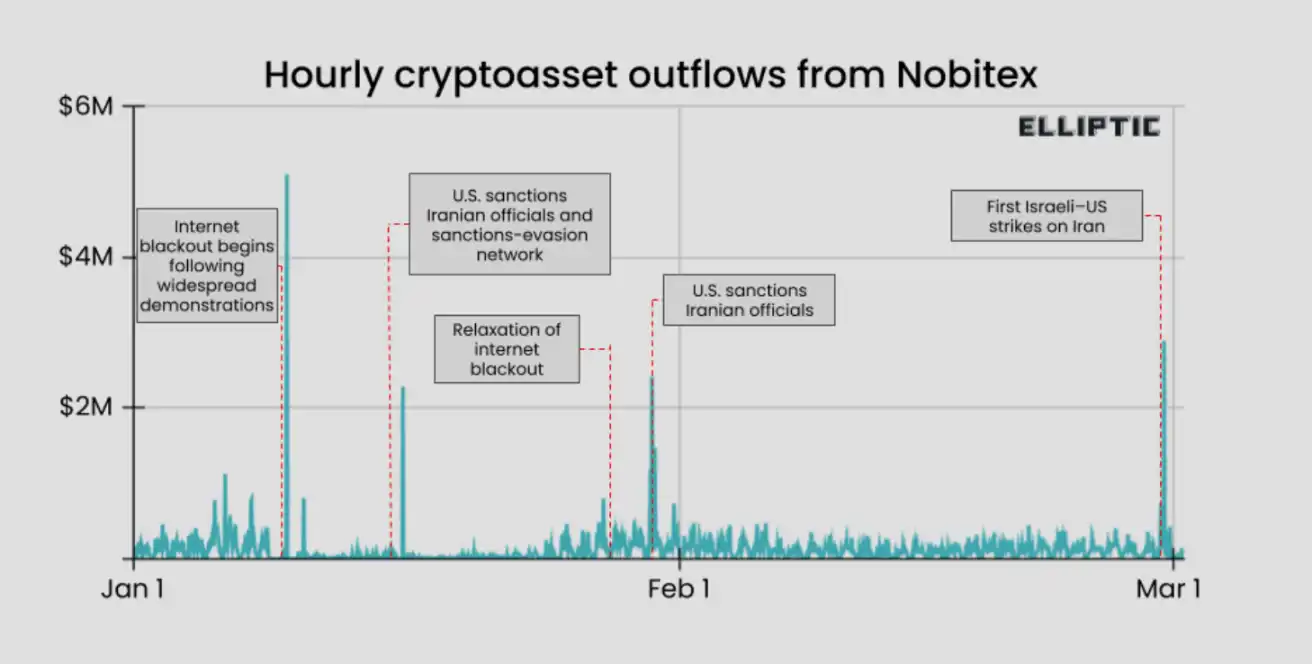
Triple Peak, Three Trigger Points — Sanctions, Internet Shutdown, Airstrike — together outline a pattern: whenever Iran's political or military risk rises, cryptocurrency becomes the first choice for capital flight.
Why Crypto, Not Banks?
The answer to this question lies in Iran's decades-long history of sanctions.
Since the 1979 Islamic Revolution, Iran has been under severe sanctions from the United States and Western countries, cut off from the SWIFT international payment system. Domestic residents can hardly transfer wealth overseas through traditional banking channels. Cryptocurrencies provide a detour: Iranian Rial is exchanged for stablecoins like USDT, then transferred overseas through on-chain transactions to foreign wallets, eventually entering overseas trading platforms. The entire process does not need to go through any traditional banks, and the tentacles of sanctions interception are hard to reach.
The collapse of the Rial also provides the most intuitive escape motive. In early 2025, 1 USD exchanged for about 81.75 million Rials; by January 2026, the exchange rate had dropped to 150 million Rials; after the airstrike, the Rial hit a historic low in a single day, falling to 175 million Rials per 1 USD.
Against the backdrop of long-term international sanctions and geopolitical conflicts, food prices in Iran have risen by over 72% year-on-year, and the national inflation rate has reached 42.5%. At the time of the 1979 Islamic Revolution, 1 USD could only exchange for about 70 Rials. This means that over more than forty years, the purchasing power of the Rial has shrunk by over 25,000 times, and the wealth of the people has been almost ground to powder under the wheel of time.
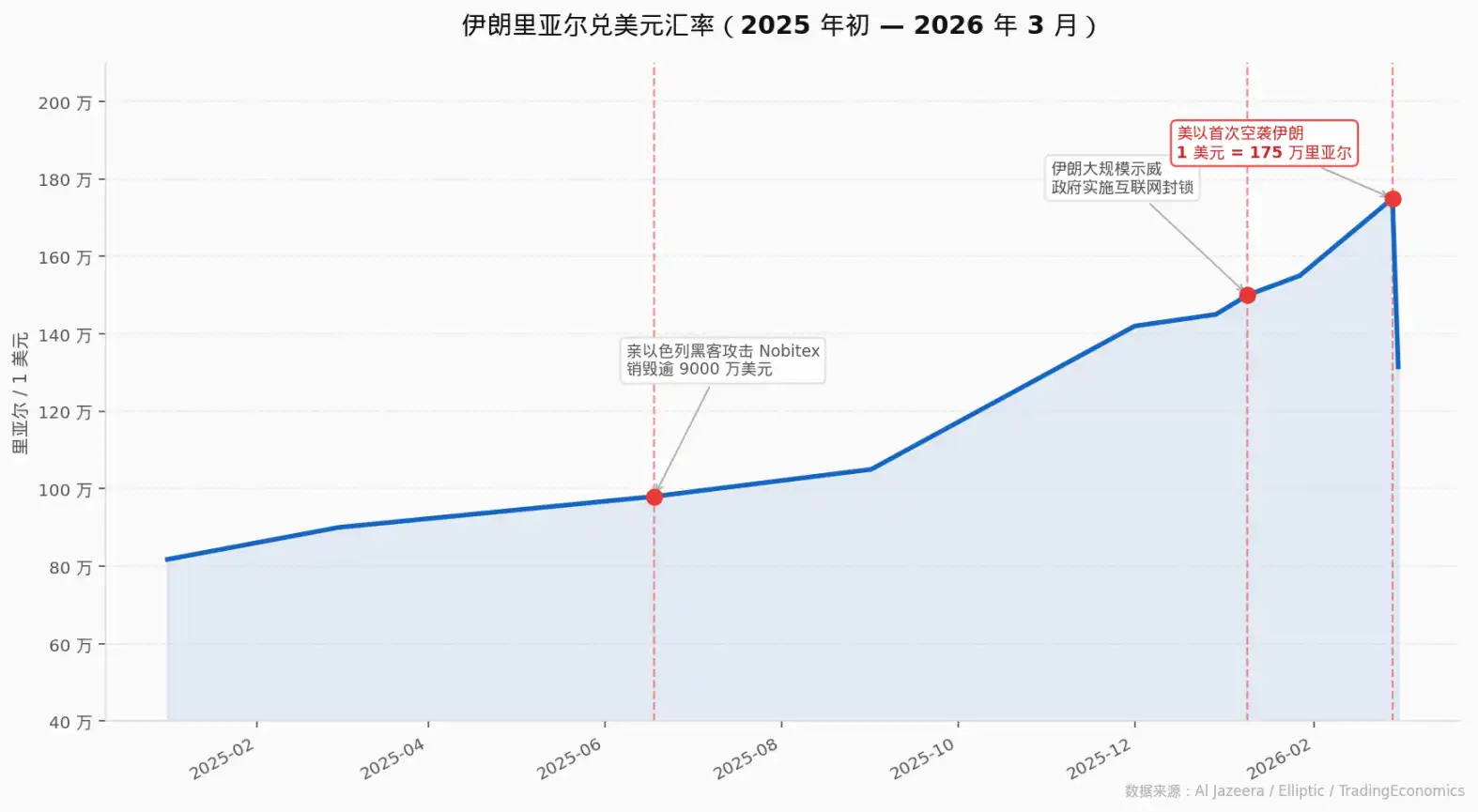
Previously, U.S. Treasury Secretary Benson publicly admitted during a congressional hearing that the United States actively created a shortage of U.S. dollars in Iran, causing the Rial to collapse rapidly, and classified this as part of the U.S.'s strategy against Iran.
What is even more noteworthy is that this route is not only used by ordinary people. Elliptic's research shows that the Central Bank of Iran itself holds at least $500 million in USDT through Nobitex as a reserve means to support the Rial exchange rate and evade sanctions. The government controls crypto on one hand and relies on crypto on the other — this contradiction itself illustrates that cryptocurrency has become irreplaceable in a sanctioned economy.
The Historical Pattern of War and Crypto Outflows
The Iran case is not unique, but a pattern that has been repeated in multiple countries.
In February 2022, Russia invaded Ukraine, prompting the West to impose the harshest-ever financial sanctions on Russia, including excluding its main banks from the SWIFT system. The ruble plummeted, and trading volumes of Bitcoin and USDT within Russia quickly surged. However, the situation in Russia differs from that of Iran: constrained by the liquidity of the crypto market, large-scale national sanction evasion is difficult to achieve, and actual outflows are relatively limited.
In August 2021, the Taliban took control of Afghanistan, reaching a peak of about $150 million in cryptocurrency outflows that month, mainly from capital flight by the Kabul elite. The Taliban subsequently announced a ban on cryptocurrency, leading the market to collapse.
Overall, the pattern is clear: War or crisis triggers a surge in cryptocurrency outflows. What sets Iran apart is that the outflows here have formed a systemic rhythm, not just a sporadic response but a normalized channel for capital flight.
You may also like

Full text of the Federal Reserve's decision: Maintain interest rates unchanged and expect one rate cut within the year, with Governor Mulan casting a dissenting vote

Guarding billions in assets, yet unable to sustain itself: Tally bids a dignified farewell after five years

SEC’s Stance on Crypto Assets: Most Not Considered Securities
Key Takeaways: The SEC’s new interpretation categorizes most crypto assets as non-securities under federal law. This move aims…

South Korea’s New Crypto Seizure Guidelines After Asset Mismanagement Incidents
Key Takeaways: South Korea’s National Police Agency (KNPA) has drafted guidelines for crypto seizure, with a focus on…

Institutional Confidence in Crypto’s 2026 Growth Trajectory
Key Takeaways: A significant 73% of institutional investors plan to increase their crypto holdings by 2026. Exchange-traded products…

Ethereum Reduces Bridge Times by 98% with Fast Confirmation Rule
Key Takeaways: Ethereum introduces the Fast Confirmation Rule (FCR) aiming to cut bridge times from L1 to L2…

Crypto Firms Advocate DeFi Education in US Colleges
Key Takeaways: Twenty-one crypto organizations have called on US colleges to integrate decentralized finance (DeFi) into their curricula…

RedotPay Reorganizes Amidst Funding Tries and IPO Goals
Key Takeaways: RedotPay is facing leadership changes and concerns over its connections with mainland China while eyeing a…

Bitcoin ETF Streak Nears October Highs While Inflows Lag Behind
Key Takeaways: US spot Bitcoin ETFs have continued their inflow streak for seven straight days, accumulating $1.2 billion…
Connecticut Suspends Bitcoin Depot as Revenue Prospects for 2026 Worsen
Key Takeaways: Connecticut halts Bitcoin Depot’s operations, citing regulatory breaches related to the Money Transmission Act. Bitcoin Depot…

DAO Governance Platform Tally Shuts Down Due to Market Challenges
Key Takeaways: Tally, after operating for five years, is shutting down due to a lack of viable business…
Trump Memecoin Shows Volatility Amid Mar-a-Lago Event
Key Takeaways: TRUMP memecoin holders surpassed 83 wallets with over one million tokens after a luncheon announcement with…
Bitcoin Surge in Australian E-commerce Faces Banking Hurdles: In-depth Analysis
Key Takeaways: Cryptocurrency usage in Australia for purchasing goods and services doubled from 6% to 12% in 2026.…

Meta Shuts Down Horizon Worlds VR for Mobile-Centric Strategy
Key Takeaways: Meta is transitioning Horizon Worlds from a VR to a mobile-centric platform starting June 2026. The…

Bitcoin Exchange Inflows Surge Amidst $75,000 Resistance
Key Takeaways: Bitcoin inflows to exchanges have spiked to 6,100 BTC, hinting at potential selling pressure. The large…
Bitrefill Identifies Lazarus Group Behind Cyberattack and Stolen Funds
Key Takeaways: Bitrefill suffered a cyberattack on March 1, likely orchestrated by the infamous Lazarus Group using sophisticated…
Coin Center Advocates for Rulemaking Over No-Action Letters in Crypto Regulation
Key Takeaways: Coin Center challenges the SEC’s reliance on no-action letters, promoting a shift toward comprehensive rulemaking in…
On the eve of the Fed meeting, are traders starting to bet on a rate hike?
Full text of the Federal Reserve's decision: Maintain interest rates unchanged and expect one rate cut within the year, with Governor Mulan casting a dissenting vote
Guarding billions in assets, yet unable to sustain itself: Tally bids a dignified farewell after five years
SEC’s Stance on Crypto Assets: Most Not Considered Securities
Key Takeaways: The SEC’s new interpretation categorizes most crypto assets as non-securities under federal law. This move aims…
South Korea’s New Crypto Seizure Guidelines After Asset Mismanagement Incidents
Key Takeaways: South Korea’s National Police Agency (KNPA) has drafted guidelines for crypto seizure, with a focus on…
Institutional Confidence in Crypto’s 2026 Growth Trajectory
Key Takeaways: A significant 73% of institutional investors plan to increase their crypto holdings by 2026. Exchange-traded products…
Ethereum Reduces Bridge Times by 98% with Fast Confirmation Rule
Key Takeaways: Ethereum introduces the Fast Confirmation Rule (FCR) aiming to cut bridge times from L1 to L2…


 App
App