
Bitcoin End-of-Year Volatility - What Were the Reasons?


On the last day of 2024, Bitcoin experienced a brief plunge to $92,000, resulting in a total of $277 million in liquidations across the network in the past 24 hours. Of this amount, long positions were liquidated at $185 million, while short positions were liquidated at $92.16 million. Meanwhile, as the U.S. stock market opened, both crypto-related stocks and the "Big Seven" of the U.S. stock market saw a widespread decline, with the Dow Jones falling by 1.04%, the S&P 500 Index dropping by 1.13%, and the Nasdaq declining by 1.33%.
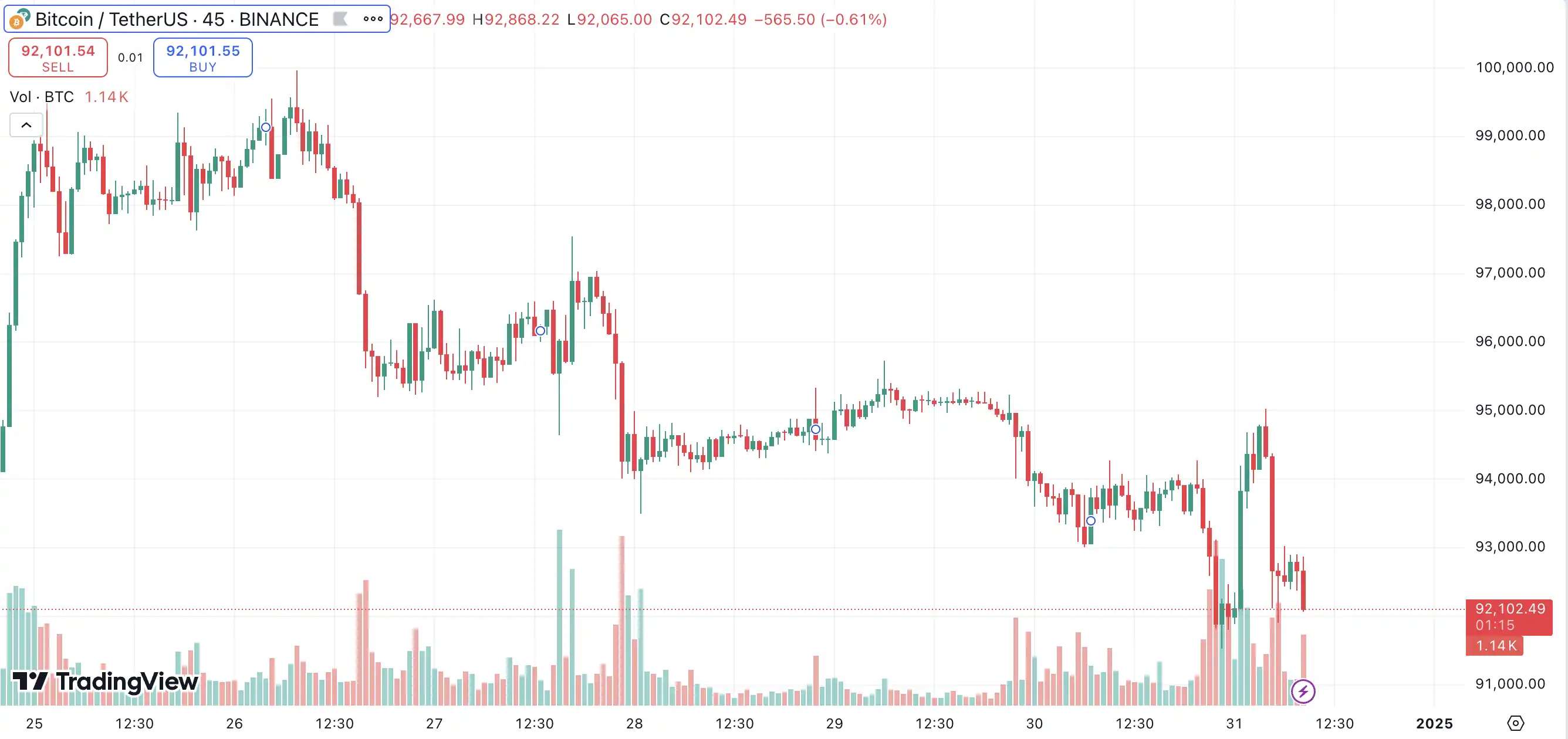
Since entering the Christmas market trend in late December, Bitcoin has experienced multiple sudden plunges. Below are the market reasons for Bitcoin's recent downturn compiled by BlockBeats for reference.
Strength of the U.S. Dollar and Unpopularity of U.S. Stocks and the Crypto Market
According to data from Bank of America, the U.S. stock market saw approximately $35 billion in outflows in the past week, marking the highest weekly outflow since December 2022. In addition, Goldman Sachs' trading desk estimates that U.S. pensions will sell $21 billion worth of U.S. stocks by the end of December this year due to the trends in stocks and bonds, and will purchase an equivalent amount of bonds.
On the past Friday, the yield on the 10-year U.S. Treasury note rose by nearly 1% to 4.629%, nearing a seven-month high. The U.S. stock market may face the risk of massive fund sell-offs. Wall Street analysts believe that in the current absence of major news, data, and light trading, the 10-year U.S. bond yield, as an anchor for asset pricing, will have an impact on the stock market. The higher the yield, the greater the pressure on the stock market.
As the strength of the U.S. dollar has pushed down global currencies and assets, including Bitcoin, dollar-denominated assets become more attractive compared to cryptocurrency in a strengthening dollar environment. Investors prefer traditional investments such as U.S. Treasuries or stocks, which produce returns in a strong dollar environment. Additionally, with declining liquidity and year-end profit-taking by investors, the possibility of further gains in cryptocurrency has been weakened.
Outflows in Bitcoin Spot ETFs
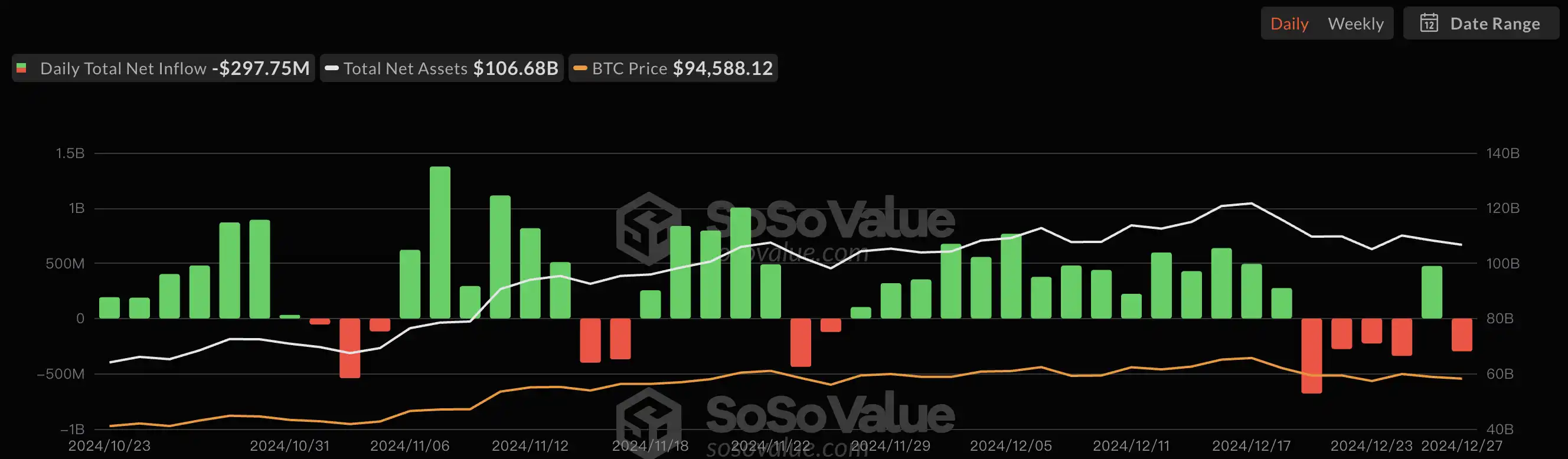
Data from Bitcoin spot ETFs have transitioned from a net inflow status seen during the "Trump Rally" to a net outflow status, with a total net outflow of $377.6 million last week, and a daily net outflow yesterday. On December 27, Fidelity's FBTC saw a net outflow of $208 million, setting a new all-time high for single-day net outflows.
Options Expiration and End-of-Quarter Volatility Sell-off
On December 17, QCP indicated that the options market had sent some cautious signals. Even as the spot price continued to hit new highs, the options market exhibited a persistent skew towards put options relative to call options—perhaps reflecting investors' preference for risk hedging rather than aggressively chasing the uptrend.
On December 28, BTC and ETH options with a notional value of nearly $20 billion were set to expire, almost half of Deribit's total OI. Meanwhile, the Bitcoin price dropped from $97,000 to $94,000 on the same day. QCP believes this was a typical end-of-quarter volatility sell-off, especially considering the continued spot volatility and option sellers continuing to close positions.
Greeks.live analyst Adam also posted on social media, stating that the skew differences between option expiries have widened. Since the bull market at the end of this year, the skew between expiries has been very close, fluctuating around 5%, with most differences not exceeding 1%. However, as recent adjustments have taken place, the differences have started to widen, with the short-term skew experiencing a greater decline. These data indicate a significant decrease in market enthusiasm, with option market participants showing reduced optimism for January.
Stablecoin Minting Volume Declines, USDT FUD Affects Market Confidence
Since December, the minting volume of stablecoins has seen a significant drop. Only on the 13th, Tether minted an additional 1 billion USDT on Ethereum, and USDC's minting volume in December was only 200 million. However, since November 6, Tether has minted 21 billion USDT on Ethereum and Tron blockchains.
Today, the EU's MiCA regulation officially came into effect, but Tether's USDT has not yet received regulatory approval, raising concerns about its future in the EU market. MiCA imposes strict requirements on stablecoin issuers, such as Tether, regarding capital reserves and liquidity, which could lead to their exit from the EU market. Some EU exchanges have already begun taking measures to comply with the new rules, with Coinbase Europe delisting stablecoins like USDT.
Nevertheless, Tether's significant market capitalization and global adoption make it unlikely to suffer an immediate financial shock. Tether's CEO Paolo Ardoino posted on social media, stating, "Don't believe FUD. Competitors are just eager to make you believe in things that don't exist. USDT is safe."
It is worth noting that Tether itself has not faced any financial issues or engaged in any illegal activities. Tether will focus on supporting new stablecoin projects, such as launching stablecoins EURQ and USDQ that comply with MiCA standards. However, given the stablecoin industry's previous history of collapses, short-term USDT FUD can still affect market confidence.
You may also like

What is the connection between Huang Zheng of Pinduoduo and blockchain?

Morning Report | Prediction market platforms like Kalshi and Polymarket jointly sue Kentucky over 14.25% trading tax; Bridgewater founder discusses decision-making in the AI era: principled thinking should run parallel to AI, human insight remains irre...

If the AI bubble has already burst, who will truly remain?

Paul Graham: How to Make a Billion Dollars

After 18 years, blockchain has finally started to head towards the main channel

Claude enforces "facial recognition for household registration," starting in July, no ID card means no access?

On the day of SpaceX's IPO, the first real test of the three perpetual mechanisms

Value Distribution of Stablecoins
Galaxy Deep Dive: Is the Bitcoin Four-Year Cycle Still Valid?

SpaceX IPO, Nvidia, and Bitcoin: Why Traders Are Watching More Than Just Crypto in 2026

The other side of Musk's trillion-dollar fortune: 85% cannot be sold

The U.S. government prohibits foreigners from using Fable 5, Anthropic issues a rebuttal

Citibank releases "2030 Asset Tokenization Market Outlook": 6 major trends may create a $8.2 trillion market

The trillion-dollar valuation test: Are the three major super IPOs a celebration for tech stocks or a nightmare for the crypto market?
Morning Report | Digital Asset completes $355 million financing led by a16z Crypto; Meta completes operational separation from Manus
a16z Crypto Partner: Cash flow is the moat

Cryptocurrency market makers collectively seek change as it becomes increasingly difficult to make money

How TradeXYZ, xStocks, and Alpaca break down the SpaceX IPO into three different strategies
What is the connection between Huang Zheng of Pinduoduo and blockchain?
Morning Report | Prediction market platforms like Kalshi and Polymarket jointly sue Kentucky over 14.25% trading tax; Bridgewater founder discusses decision-making in the AI era: principled thinking should run parallel to AI, human insight remains irre...
If the AI bubble has already burst, who will truly remain?
Paul Graham: How to Make a Billion Dollars
After 18 years, blockchain has finally started to head towards the main channel
Claude enforces "facial recognition for household registration," starting in July, no ID card means no access?


