
Coinbase Report: Younger Generation No Longer Buying Homes or Stocks, Cryptocurrency Becomes Primary Wealth Battlefield

Original Title: State of Crypto Q4 2025: Younger investors are rewriting the investing playbook
Original Source: Coinbase
Original Translation: Chopper, Foresight News
For decades, the wealth accumulation path for Americans has remained almost unchanged: find a good job, buy real estate, invest in stocks, and then patiently wait for the power of compounding over time. However, our latest "Cryptocurrency Industry Report" shows that the younger generation of investors no longer believes in this traditional path and is adjusting their investment behavior.
To understand the market strategies of different generational groups and the role of cryptocurrency in their portfolios, Coinbase conducted a special study in partnership with Ipsos, interviewing a total of 4,350 US adults, including 2,005 investors with investment accounts. The core findings of the study are as follows: Generation Z and millennial investors, among other young investors, are more inclined than any previous generation to actively manage their investments, more willing to embrace non-traditional assets, and are more likely to view cryptocurrency as a core part of their financial future.
A Generation Excluded from the Traditional Wealth Ladder
Youthful investors are far more optimistic about the economy than older generations, but they believe that the existing financial system is not designed for them. Research data shows that nearly seventy percent (73%) of young people believe that their generation faces greater difficulty in accumulating wealth through traditional means compared to their parents' generation, while only 57% of the older generation share the same view.
They have witnessed housing costs skyrocket, student debt pile up, and wage growth stagnate. In this context, an increasing number of young people are seeking alternative wealth accumulation methods beyond the traditional model of "home equity + stock portfolio."
Non-Traditional Asset Allocation Ratio Triples that of Older Generations
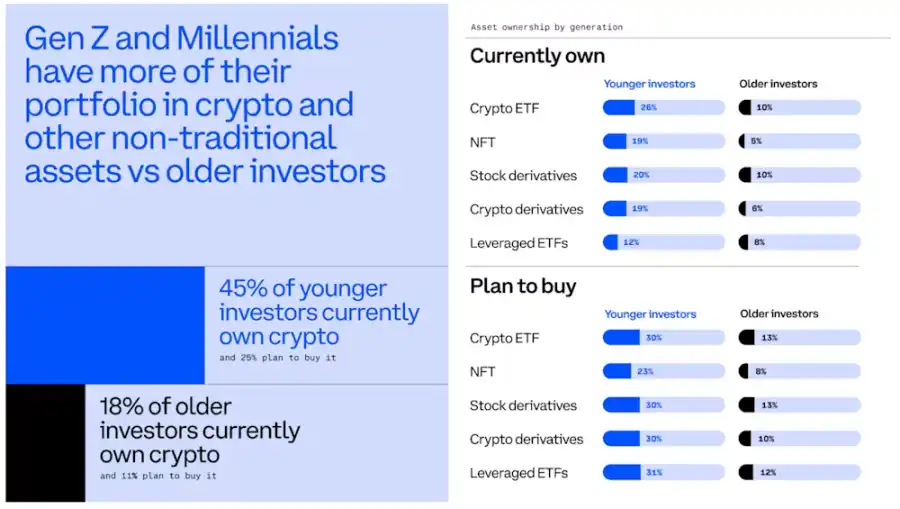
This anxiety is directly reflected in their asset allocation strategy. The research shows that young investors allocate 25% of their portfolio to non-traditional asset categories such as cryptocurrency, financial derivatives, non-fungible tokens (NFTs), and other emerging products. This ratio is three times that of older investors, whose allocation to non-traditional assets is only 8%.
The stock holding ratios of different generational cohorts are roughly similar, with the core difference being that young investors have diversified their portfolios beyond stocks. They are more actively seeking income opportunities beyond traditional stock dividends and, in order to narrow the wealth gap, are more willing to explore various new investment tools and emerging markets.
Cryptocurrency is by no means a side investment, but a core allocation
This shift in generational investment philosophy is most evident in the level of acceptance of cryptocurrency. The report shows that 45% of young investors already hold cryptocurrency, compared to only 18% among older investors. Furthermore, nearly half (47%) of young investors hope to be the first to access new types of crypto assets before the mainstream market; in contrast, only 16% of older investors have this aspiration.
In the eyes of the younger generation, cryptocurrency is not simply for speculative trading but is seen as an important avenue to help them catch up in wealth accumulation. Eight out of ten young people believe that cryptocurrency provides their generation with more financial opportunities outside the traditional financial system; at the same time, another eight out of ten young people firmly believe that the role of cryptocurrency in the future financial system will be greatly enhanced. In comparison, the proportion of older investors who agree with this view is only about sixty percent.
The younger generation's enthusiasm for exploring emerging markets is not limited to spot cryptocurrencies; they also aspire to engage with more non-traditional assets. Data shows that eight out of ten young investors are willing to be early adopters of new investment opportunities, a percentage that is still less than half among the older generation holding the same attitude. Young investors are always keenly interested in emerging non-traditional products such as cryptocurrency derivatives, prediction markets, 24/7 stock trading, early token sales, altcoins, decentralized finance lending, and more.
The impact of this trend on future markets
The young investor cohort has shown distinct traits: they trade more frequently, are willing to take on greater risks for higher returns, and are shifting a considerable portion of their portfolios towards non-traditional assets with cryptocurrency at the core. At the same time, they are driving the entire financial industry towards a transformation that better aligns with the needs of the internet-native generation, creating platforms that operate around the clock and support multi-asset trading.
You may also like

Argentina vs Cape Verde: When a Record-Breaking Legend Meets an Unbreakable Underdog
WEEX exclusive pre-match analysis of Argentina vs Cape Verde, exploring Messi-led Argentina’s dominance and Cape Verde’s historic defensive breakout, with a breakdown of volatility, structure, and match dynamics.
How does Gate redo "buying and selling stocks" from the cryptocurrency world to the stock market?
Former ByteDance employee's account: How I started with two Pinduoduo hard drives and made six times the profit with Seagate to achieve financial freedom?
Visa and Mastercard join 140 giants to launch a new stablecoin, but the impact on the market landscape may still be limited
WEEX Launches Depth Chart for Spot Trading
MiCA reshuffle begins, Binance temporarily bids farewell to the EU
Raising interest rates to protect STRC and selling coins to maintain credit, this time the strategy has chosen the two most expensive paths
Morning Report | Samsung announces a 265.5 trillion won investment plan, focusing on semiconductor and AI computing power data centers; Vitalik publishes an article detailing the entire technology tree behind the confusion protocol (iO) mainline
In the era of AI, what is left of Bitcoin?
NeoSoul announced plans to integrate with the OKX Agentic Wallet, promoting AI agents' participation in the on-chain economy
Why Is Bitcoin Lagging Stocks in 2026? AI Stocks, ETF Outflows, and the Nasdaq Rally Explained
What you bought on CEX is really not US stocks: Analyzing the 94% liquidation monopoly and the evaporation of equity under a five-layer pipeline
In such a crowded cross-border payment arena, where is the next stop for the future?
Why Is Bitcoin Down in 2026? What We Can Learn From 2022
The large models in the United States are moving towards closure in the name of security
From the white-haired stock god to the billionaire fund mogul, the smart people shorting Nvidia are all getting rich using the same framework
Morning Report | CoinEx becomes a key hub for Iran to evade sanctions, involving over $3.8 billion in funds; Kalshi seeks a new round of financing, with a valuation potentially rising to $40 billion
Global Launch: As predictions become the most scarce asset in the AI era, Manadia is defining the next generation of the value internet
Argentina vs Cape Verde: When a Record-Breaking Legend Meets an Unbreakable Underdog
WEEX exclusive pre-match analysis of Argentina vs Cape Verde, exploring Messi-led Argentina’s dominance and Cape Verde’s historic defensive breakout, with a breakdown of volatility, structure, and match dynamics.
How does Gate redo "buying and selling stocks" from the cryptocurrency world to the stock market?
Former ByteDance employee's account: How I started with two Pinduoduo hard drives and made six times the profit with Seagate to achieve financial freedom?
Visa and Mastercard join 140 giants to launch a new stablecoin, but the impact on the market landscape may still be limited
WEEX Launches Depth Chart for Spot Trading
MiCA reshuffle begins, Binance temporarily bids farewell to the EU


