
CoinGecko Spot Report: Overview of 12 Major CEX Spot Markets, Only 32% of New Tokens Outperforming IEO Price


Original Article Title: Spot CEX Report 2026
Original Source: CoinGecko
Original Translation: Deep Tide TechFlow
Deep Tide Summary: CoinGecko has released the 2026 Spot CEX Report, covering the top 12 global centralized exchange platforms. The report revealed several key facts: USDT and USDC account for nearly 98% of stablecoin trading pairs; only 32% of newly listed tokens outperformed their issuance price in the short term, with almost all dipping below the issuance price after 12 months; total reserves on exchanges increased from $1.521 trillion to $2.254 trillion; funds are flowing from institutional platforms like Coinbase to retail-driven platforms like Bitget and MEXC.
Since the birth of the crypto market, centralized exchange platforms (CEXs) have been the core gateway for both retail and institutional players to access liquidity. In just 2025, the spot markets of the top 12 CEXs processed nearly $21 trillion in trading volume. As the industry matures, the focus of the market is shifting towards the sustainability of spot trading activity and the health of the underlying reserves supporting these massive trades.
The competitive landscape of CEXs is evolving. USDT and USDC dominate trading pairs, and the performance of newly listed coins remains a significant challenge. The total reserves of the top 12 CEXs in 2026 reached $2.254 trillion, with funds moving from institutional giants towards high-turnover, retail-driven platforms.
Below are the four key findings of the report. The full report spans 21 pages, and it is recommended to download and read.
1. USDT and USDC Account for 66.6% of Trading Pairs, Stablecoins Almost Monopolize Spot Trading
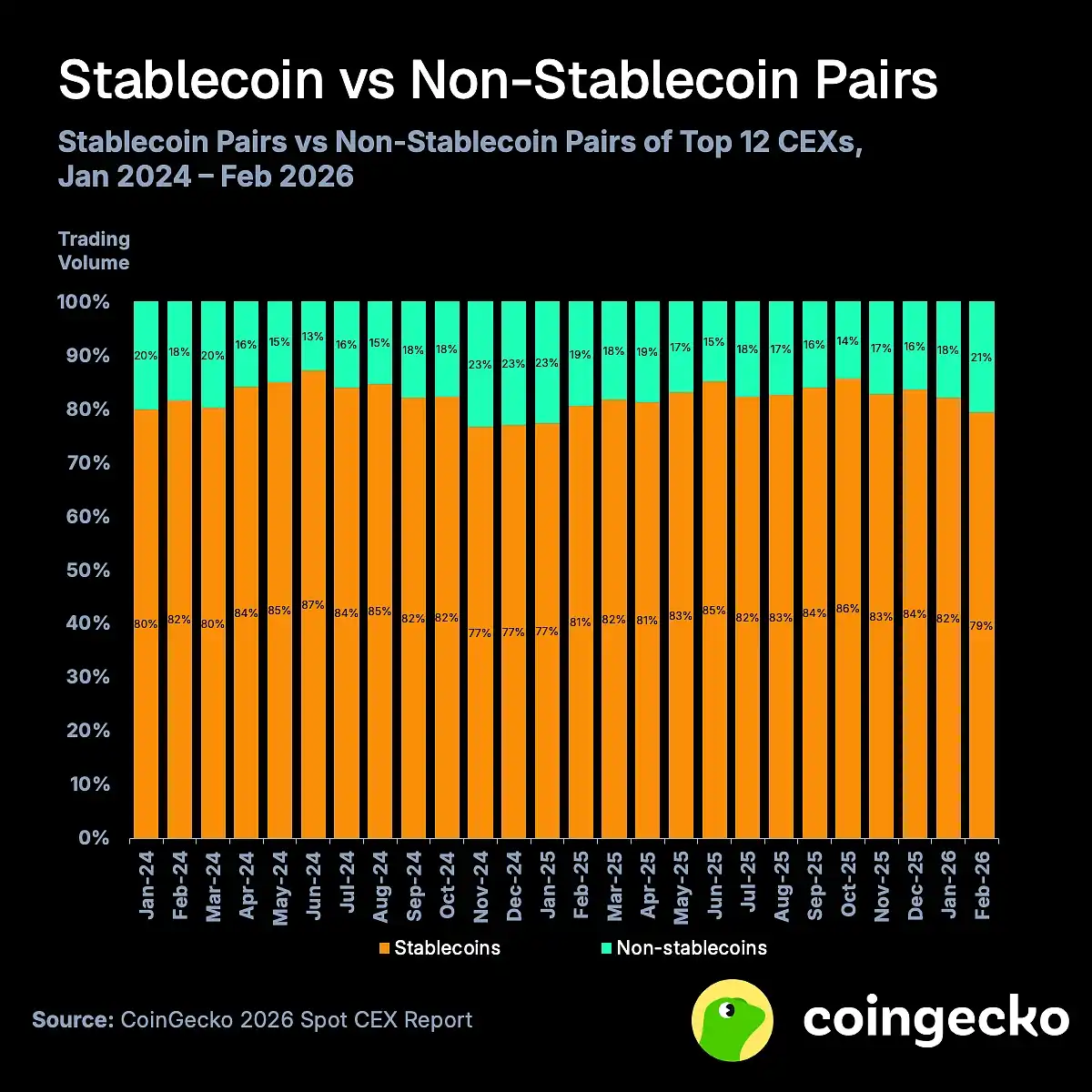
Figure: Proportion of Stablecoin and Non-Stablecoin Trading Pairs on the Top 12 CEXs
The vast majority of spot trading volume on the top 12 CEXs is completed through stablecoin trading pairs like USDT and USDC.
Specifically, out of 9,870 stablecoin trading pairs, 9,646 are USDT or USDC pairs, accounting for 97.7%. There are a total of 4,615 non-stablecoin trading pairs, representing 31.9% of all 14,485 trading pairs.
However, the number of trading pairs does not directly correlate with trading volume. The share of non-stablecoin trading pairs reached its peak in November 2024, at only 23%.
2. Peak of New Coin Listing: Only 32% Saw Short-Term Gains, Nearly Wiped Out After 12 Months
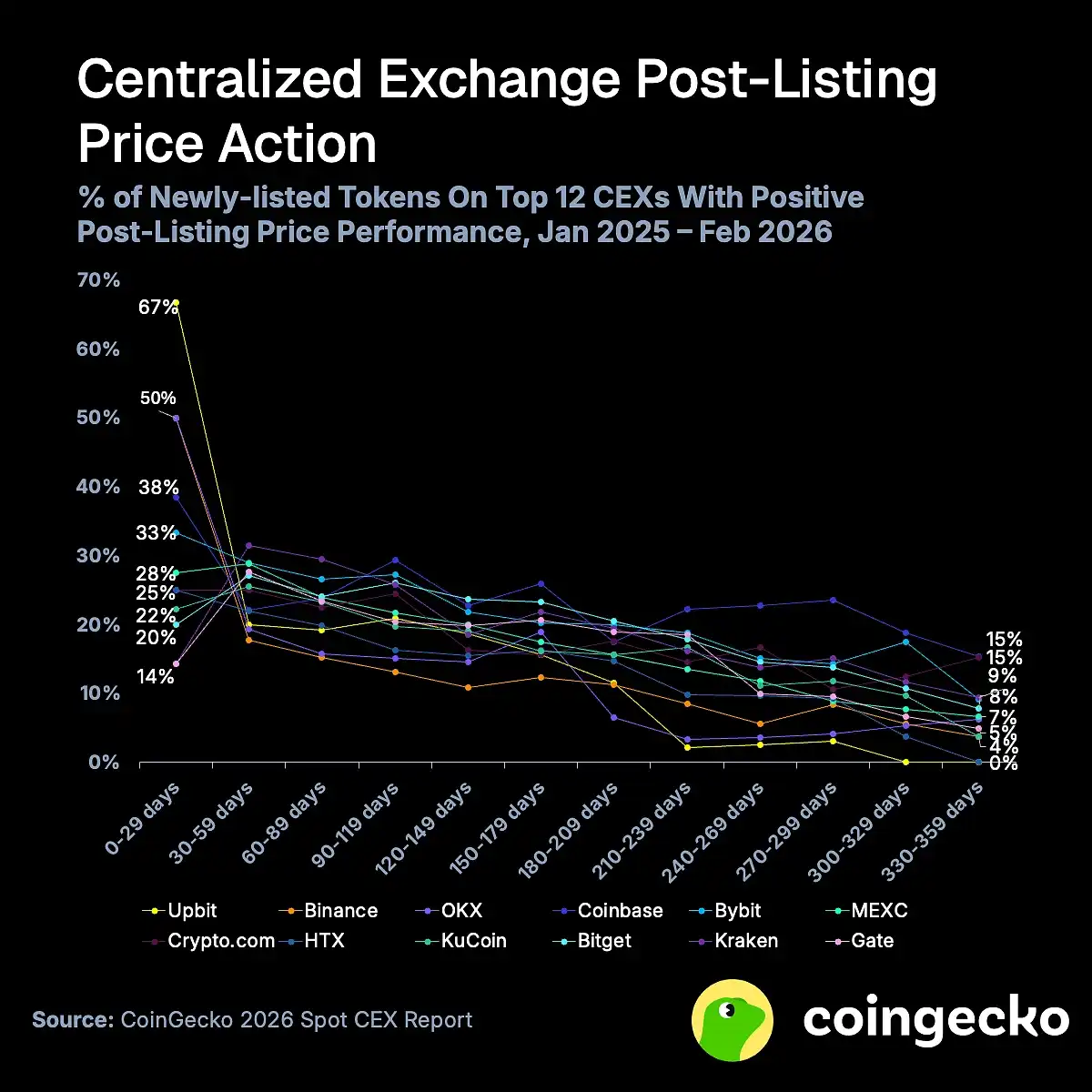
Chart: Price Performance of 12 Major CEX-Listed Tokens
Among the top 12 exchanges, Upbit had the best short-term performance after listing new coins, with 67% of new coins still profitable after 30 days of listing. However, Upbit also had the fewest listings. Following Upbit were Binance and OKX, with a 50% profit rate after 30 days.
There was a significant performance difference among exchanges in the first 0-29 days after listing, but the gap rapidly narrowed after 30 days. On average, only 25% of tokens were still profitable 30-59 days after listing.
Looking at a longer time frame, the performance of exchanges tended to linearly decline. The only exception was Coinbase, where newly listed tokens saw a "recovery" six months after listing.
By the 12-month mark, in most tokens listed on major exchanges, less than 10% were trading above the listing price. Upbit's data was particularly dramatic: starting strong but crashing the fastest, by days 300-329, all newly listed tokens were trading below the listing price.
3. Total Reserves of 12 Major CEXs Increased from $152.1B to $225.4B, Binance Doubled its Lead
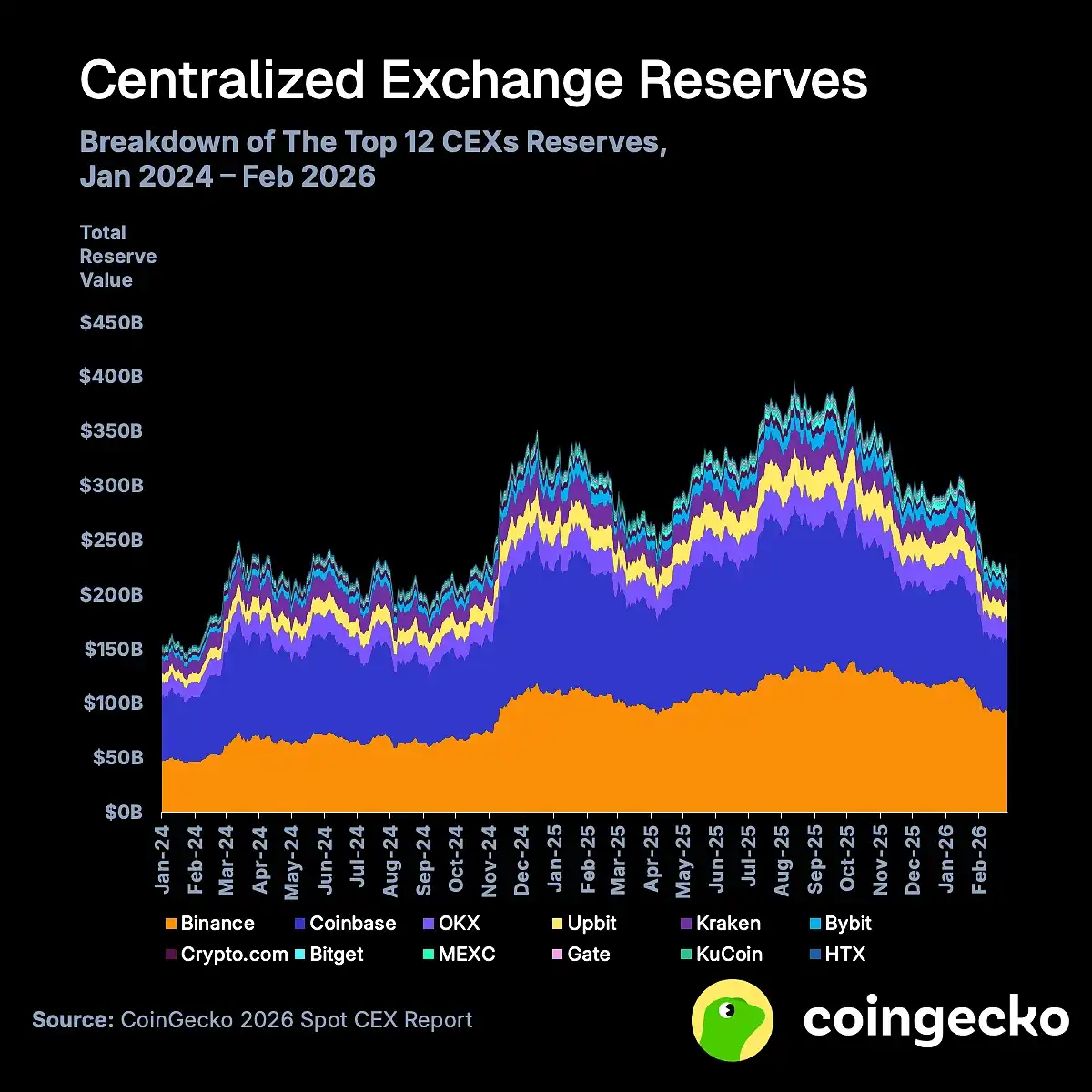
Chart: Changes in Value of 12 Major CEX Reserve Assets (2024-2026)
Despite the price surge of BTC and ETH boosting the reserve value of most exchanges, price volatility and stricter regulations are driving users to move funds from large exchanges to other platforms.
From early 2024 to the end of February 2026, the total value of underlying assets of the top 12 CEXs grew by an average of 69.6%, rising from $152.1 billion to $225.4 billion.
8 of the exchanges saw a net reserve gain, with Binance in the lead by far, doubling its reserves from $46.7 billion to $93.4 billion over 2 years.
With respect to BTC reserves, Coinbase holds the top spot with over 800k BTC, followed closely by Binance with 669k BTC. However, Coinbase saw net outflows of 20% and 41% of its BTC and ETH reserves, respectively.
A significant portion of these outflows flowed into smaller exchanges like Bitget and MEXC. The reserve value of these two platforms surged by 262.0% and 274.6%, respectively.
4. Retail-Centric Exchanges See Much Higher Capital Velocity Than Institutional Ones, With MEXC Turnover Rate 20x That of Coinbase
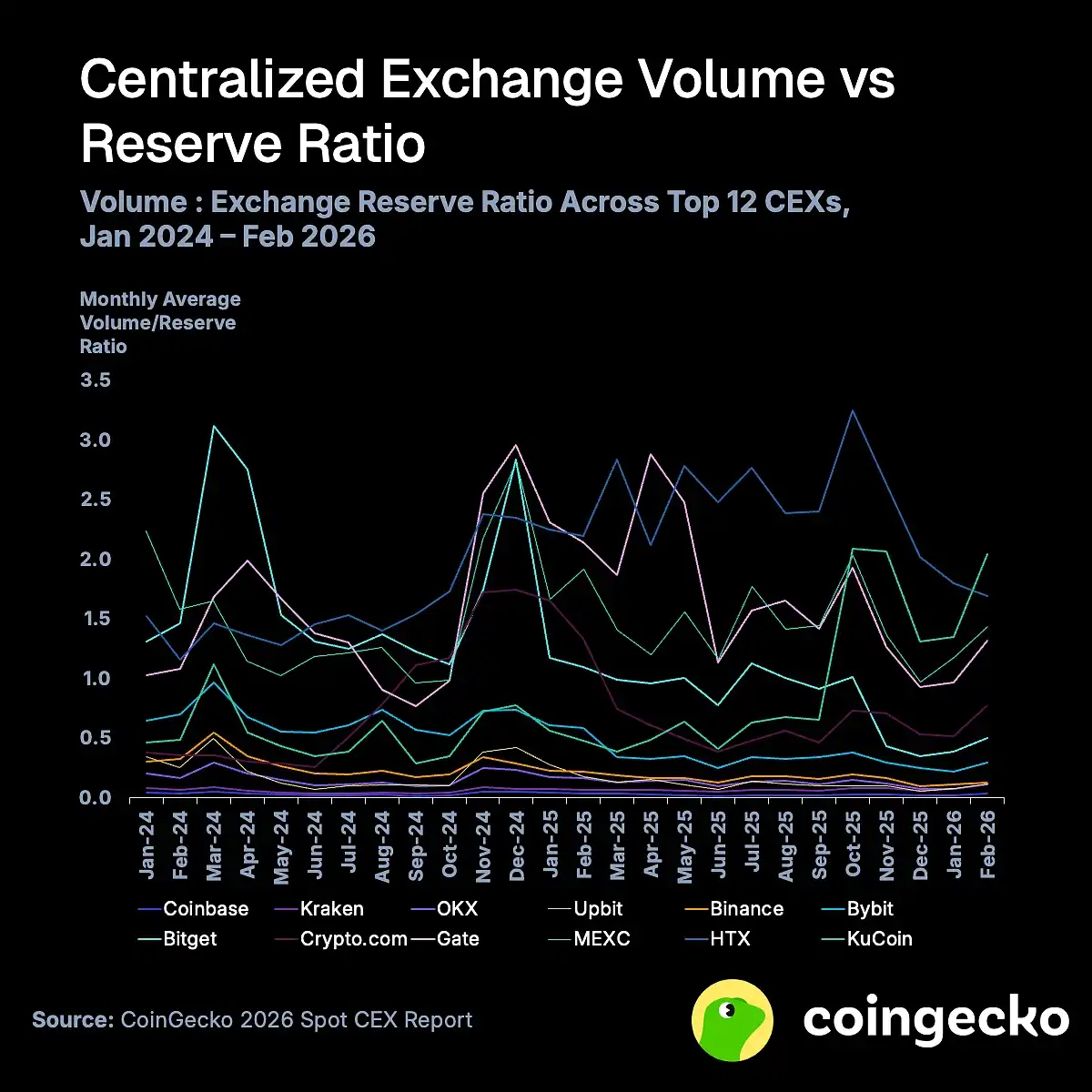
Figure: Comparison of the trading volume and reserve ratios of the top 12 CEXs
While CEXs hold significant crypto asset reserves, the efficiency of capital utilization varies greatly among platforms.
Compliant exchanges like Coinbase, Binance, and Kraken have a Volume : Reserve Ratio of around 0.1. This may be because their customer base is primarily institutional, using the platforms more for custody rather than frequent trading.
Bybit and Bitget combine high trading volumes with substantial deposit sizes, with average ratios from January 2024 to February 2026 of 0.3 and 0.5, respectively.
Exchanges with smaller reserves, such as MEXC, HTX, and KuCoin, have asset turnover rates ranging from 1.44 to 2.04. This means that users' trading volume far exceeds the exchange's held reserves, with funds circulating rapidly on the platform.
You may also like

Morning News | The draft amendment to the People's Bank of China Law aims to clarify the legal status of digital renminbi; South Korea will transfer about 40 unregistered virtual asset service providers to law enforcement agencies

The cryptocurrency industry has entered the "Show Me" era: merely relying on vision is no longer enough

Interpreting the Ethereum Foundation's new structure: Reaffirming self-sovereignty amid institutional trends

Former SpaceX engineer reconstructs the financial execution system using first principles

Tidal Investment: We still have a positive outlook on the AI industry chain, but the reasons have changed

Standard Chartered Bank sings a 50x rhapsody again, aiming for AAVE to reach 3500 USD

The interim executive director of the Ethereum Foundation speaks out: What is our mission?
Why does OKX want to start a new company with the parent company of the New York Stock Exchange?

Why Is PAXG Price Different From Gold? 5 Reasons Crypto Traders Should Know

WEEX OpenAPI 101: 5 Powerful Modules, AI Trading Tools, and Grab Up to 70% Revenue Opportunities
Learn how WEEX OpenAPI connects traders, developers, AI agents, and trading platforms. Discover WEEX API features, Binance-compatible integration, automated trading workflows, revenue opportunities, and ecosystem possibilities.

Interview with NDV Founder Jason Huang: Popping the AI Bubble and the Myth of Microstrategy, Seeking the Ultimate Ace in the Crypto Market

Morning Report | Former Ethereum Foundation researcher establishes Ethlabs; EU Parliament Economic Committee passes digital euro regulatory proposal

Dragonfly partner Haseeb: The fastest-growing companies in the future may all be stuck at 149 people

How xBubble Breaks the Deadlock in VC's Heavy Investment in the OPC Economy

The encrypted unicorn Blockstream is deeply embroiled in a serious fraud case

Morning Report | The South Korean Financial Services Commission plans to expand the regulatory sandbox to include virtual assets; the parent company of the New York Stock Exchange, ICE, has reached a partnership with OKX to jointly establish a cryptocu...

Exclusive Interview with Strategy CEO: Putting Aside the Sale of 32 BTC, the 60 Trillion AI Intelligence is the Ultimate Fate of Bitcoin

TRON revitalizes the image of the bull, creating a more approachable brand character
Morning News | The draft amendment to the People's Bank of China Law aims to clarify the legal status of digital renminbi; South Korea will transfer about 40 unregistered virtual asset service providers to law enforcement agencies
The cryptocurrency industry has entered the "Show Me" era: merely relying on vision is no longer enough
Interpreting the Ethereum Foundation's new structure: Reaffirming self-sovereignty amid institutional trends
Former SpaceX engineer reconstructs the financial execution system using first principles
Tidal Investment: We still have a positive outlook on the AI industry chain, but the reasons have changed
Standard Chartered Bank sings a 50x rhapsody again, aiming for AAVE to reach 3500 USD


