

Ethereum Foundation Researcher Claims: Solana's Golden Age is Over, Will be Surpassed by ETH L2

Original Title: "Ethereum Foundation Researcher: Solana's Golden Age is Over! Two Major Advantages Will Be Overtaken by ETH L2"
Original Author: Ting, BlockTempo of Doo Wan Inc.
During this bull market cycle, the public blockchain Solana, with its fast transaction speed and low gas fees, has dominated the majority of the meme season frenzy traffic, and on November 22, the SOL token price broke through $260, hitting a new all-time high.
In contrast, the leading blockchain Ethereum has not seen significant breakthroughs in recent ecosystem development, coupled with high gas fee issues, causing on-chain users to stay away, thereby keeping the Ethereum price continuously sluggish.
However, Ethereum Foundation researcher Justin Drake recently stated that Solana's good days may be coming to an end.
Ethereum Foundation Researcher: Solana's Golden Age Coming to an End
The crypto media outlet The Defiant tweeted today (29th) that in the latest episode of the podcast, Ethereum Foundation researcher Justin Drake discussed how Ethereum Layer 2 is poised to surpass Solana in terms of latency and throughput, bluntly stating that Solana's golden age is about to end:
Bitcoin, Ethereum, and Solana: Different Focuses of Competition
Justin Drake:
To sum up this competition, you could say: on one hand, Bitcoin's competitive advantage lies in its stability, Lindy effect (historical persistence), and monetary properties; whereas Beam Chain's focus is to maximize Ethereum Layer 1's efficiency, making its competition with Bitcoin more direct. On the other hand, Solana's core is its performance.
In my model, Solana's competitor is actually Ethereum's Layer 2, not Layer 1 itself. For Solana, the good news is that it has excelled in two key performance indicators in the past year or two: latency and throughput.
Solana's Advantages Fading: Latency and Throughput
Justin Drake:
In terms of Latency, Solana has a very short slot time. However, for Ethereum, the arrival of a pre-confirmation mechanism will significantly improve latency, even surpassing Solana. Currently, Solana's average latency is 200 milliseconds. But the pre-confirmation mechanism will reduce latency to around 10 milliseconds, meaning a 20x improvement in slot latency.
In terms of Throughput, this year we have witnessed the thriving development of Layer 2. A website, rollup.wtf, shows the growth of throughput from a computational perspective (measured in gas per second). Ethereum aims to have the entire ecosystem process as many transactions as possible, and Layer 2 has demonstrated its ability to horizontally scale. Currently, the overall throughput of Layer 2 is about 100 times higher than Ethereum Layer 1, and it is very likely to grow to 1,000 times or even 10,000 times next year. This is a sustainable and scalable architecture.
Meanwhile, Solana's strategy is to concentrate all activity on a single server. Each validation node requires a large server to handle all activities, but the performance of these servers has basically reached its limit, so a significant increase in throughput is not possible. I believe Solana will not be able to increase its gas limit by 10x next year, while Ethereum is likely to expand the overall gas limit by 10x through Layer 2.
In summary, we may be about to see the end of Solana's golden age, as its two once-proud performance metrics will no longer provide a competitive advantage.
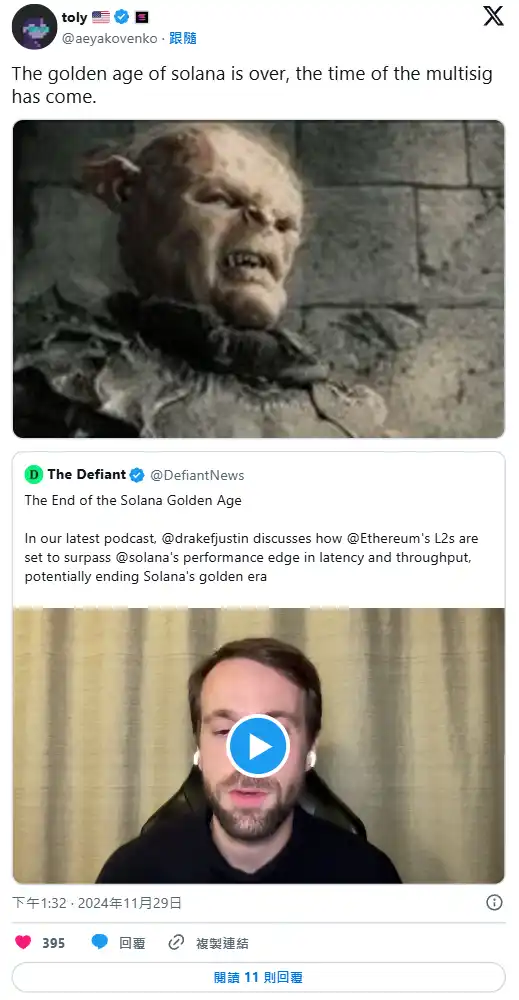
Interestingly, Solana co-founder Anatoly Yakovenko also referenced a tweet from The Defiant and an accompanying image:
"Solana's golden age is over, the era of multi-sigs has come."
This tweet seems to have a sarcastic tone, suggesting that the Ethereum Foundation lacks practical accomplishments and only uses the statement "Ethereum is about to surpass Solana" to motivate users and developers within its ecosystem. (Note: The Ethereum ecosystem places great emphasis on technologies such as multi-signature, account abstraction, etc.)
The Ethereum Foundation Invests Millions of Dollars in zkVMs
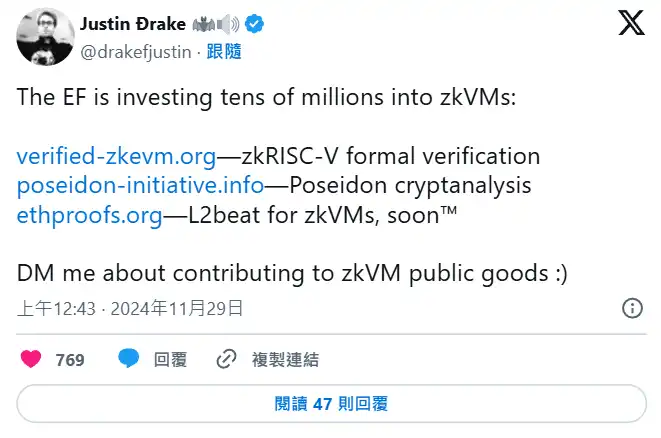
On the other hand, Ethereum Foundation researcher Justin Drake also tweeted today (29) that the Ethereum Foundation is investing tens of millions of dollars in the zkVMs project, including zkRISC-V formal verification, Poseidon cryptanalysis, and L2beat for zkVMs.
You may also like

The arrival of the Web 3.0 era: A review of Hong Kong court rulings on digital assets

Track Markets At a Glance: New WEEX Price Widgets for iOS & Android
To streamline your market data access, WEEX has officially launched "Market Watchlist" desktop widgets

The billion-dollar lesson: The focus of DeFi security is shifting from code to operational governance

A Brief Analysis of Stablecoin Licenses and On-Chain Funding
BVNK Founder: Three Stages of Stablecoin Development

The truth about Trump's son's Bitcoin game: he made a staggering $100 million while retail investors lost $500 million

What Is Futures Trading? Hours, Platforms, and How to Start Trade Futures(2026 Guide)
Learn how to start futures trading, understand trading hours, and choose the best futures trading platform. Includes real data, strategies, and ways to maximize returns with rebates.

The Rise of Composable RWA

MAGA Up 350% in 24 Hours, PEPE Up 46% in One Day: Which Memecoins Are Next in 2026?
MAGA +350% in 24hrs. PEPE +46% in one day. RAVE +4,500% then -90%. In 2026's memecoin market, the gains are real. So are the traps? Here's how to tell the difference before you buy.

RCD Espanyol vs Real Madrid: Can the Pericos Delay the Inevitable?
RCD Espanyol vs Real Madrid lineups, standings, and stats for May 3, 2026. Real Madrid visits RCDE Stadium as Barcelona closes in on the LALIGA title. Full preview inside.
MegaETH goes live with an FDV exceeding 2 billion USD. Which ecological projects are worth paying attention to?

Dialogue with "Wood Sister" Cathie Wood: The next bull market is about to arrive
Can prediction markets win the competition for perpetual contracts?

Who is trading on Trade.xyz?

Binance quietly placed a bet on a leading large model company

Best Crypto Discord Server 2026: Why Jacob’s Crypto Clan Is Gaining Massive Attention
Jacob’s Crypto Clan has grown into one of the most active crypto Discord communities, with over 45K members and continuing to expand. This rapid growth reflects strong demand for structured trading insights and real-time collaboration.

Tom Lee Buying ETH: Why Wall Street’s Loudest Ethereum Bull Keeps Doubling Down
Tom Lee keeps buying ETH through every dip, every drawdown, and every moment of market doubt. Inside the strategy that's turning Ethereum into a treasury asset — and what it signals for the rest of the market.

Stripe Sessions 2026: AI Agent, Global Payments, and Invisible Crypto Infrastructure
The arrival of the Web 3.0 era: A review of Hong Kong court rulings on digital assets
Track Markets At a Glance: New WEEX Price Widgets for iOS & Android
To streamline your market data access, WEEX has officially launched "Market Watchlist" desktop widgets
The billion-dollar lesson: The focus of DeFi security is shifting from code to operational governance
A Brief Analysis of Stablecoin Licenses and On-Chain Funding
BVNK Founder: Three Stages of Stablecoin Development
The truth about Trump's son's Bitcoin game: he made a staggering $100 million while retail investors lost $500 million


