
From Developer Ecosystem to Supply Chain, Solana's "AI Ecosystem Strategy"


Editor's Note:
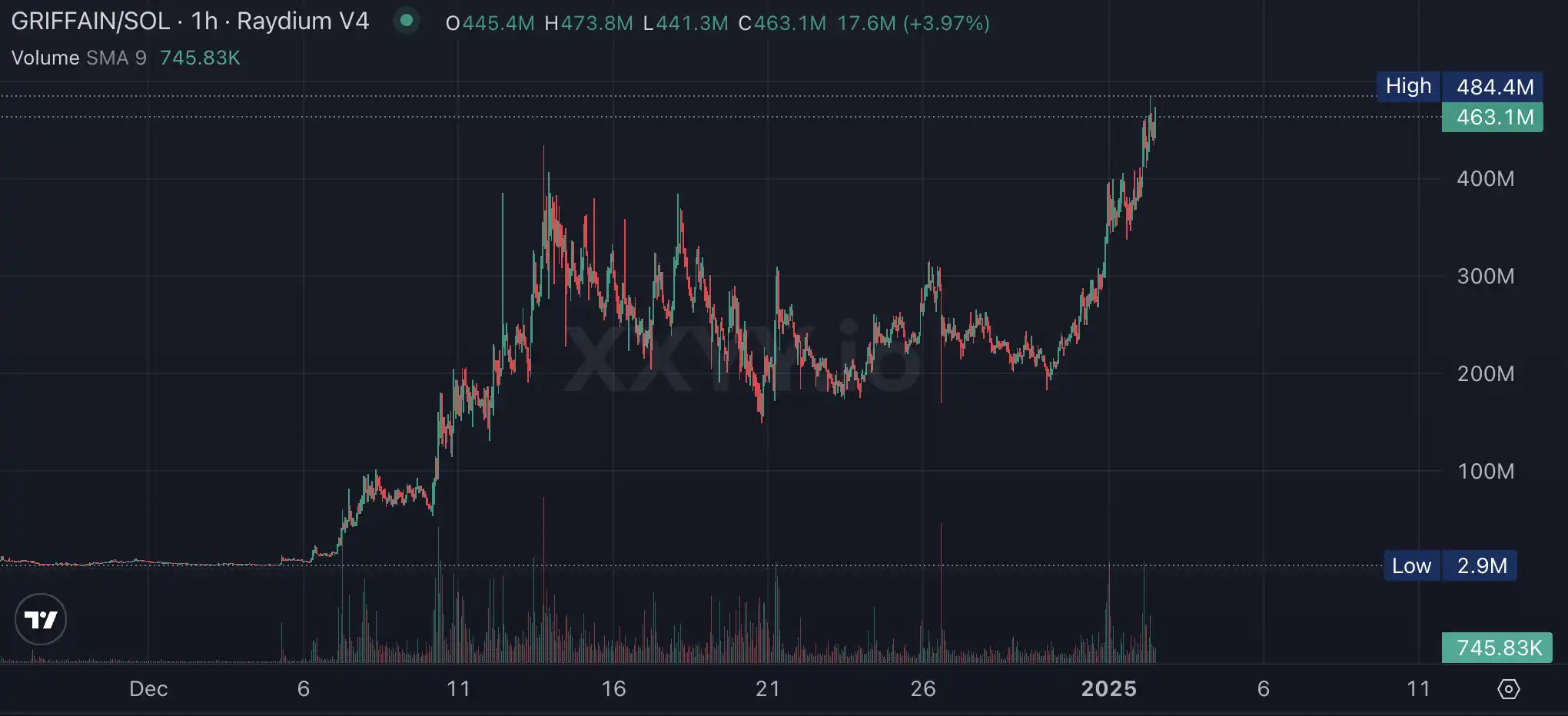
The author's first article about the Griffain and SendAI hackathon was written on December 13, when the Solana hackathon and Griffain were gaining popularity, causing a wealth effect on Solana. Today, with the full-scale outbreak of the AI market, Griffain's market value has reached an all-time high, exceeding $480 million. The SendAI token, Send, has also returned to a $100 million market value. In the highly evolving AI Agent ecosystem, what advantages and progress do Griffain and Send have?
Web3 Edition Perplexity, or Solana's App Store?
When we look back at the founder of Griffain, we find that he did not originally join Crypto but spent 6 years growing in Silicon Valley, accumulating significant development and sales experience before entering Crypto.
In September 2016, a young man from San Francisco State University pushed open the doors of Uber. And if it weren't for coincidence, you might never have known him until recently when the token of his project on the Solana chain surpassed $250 million in market value. He is Tony Plasencia, the founder of Graffin.
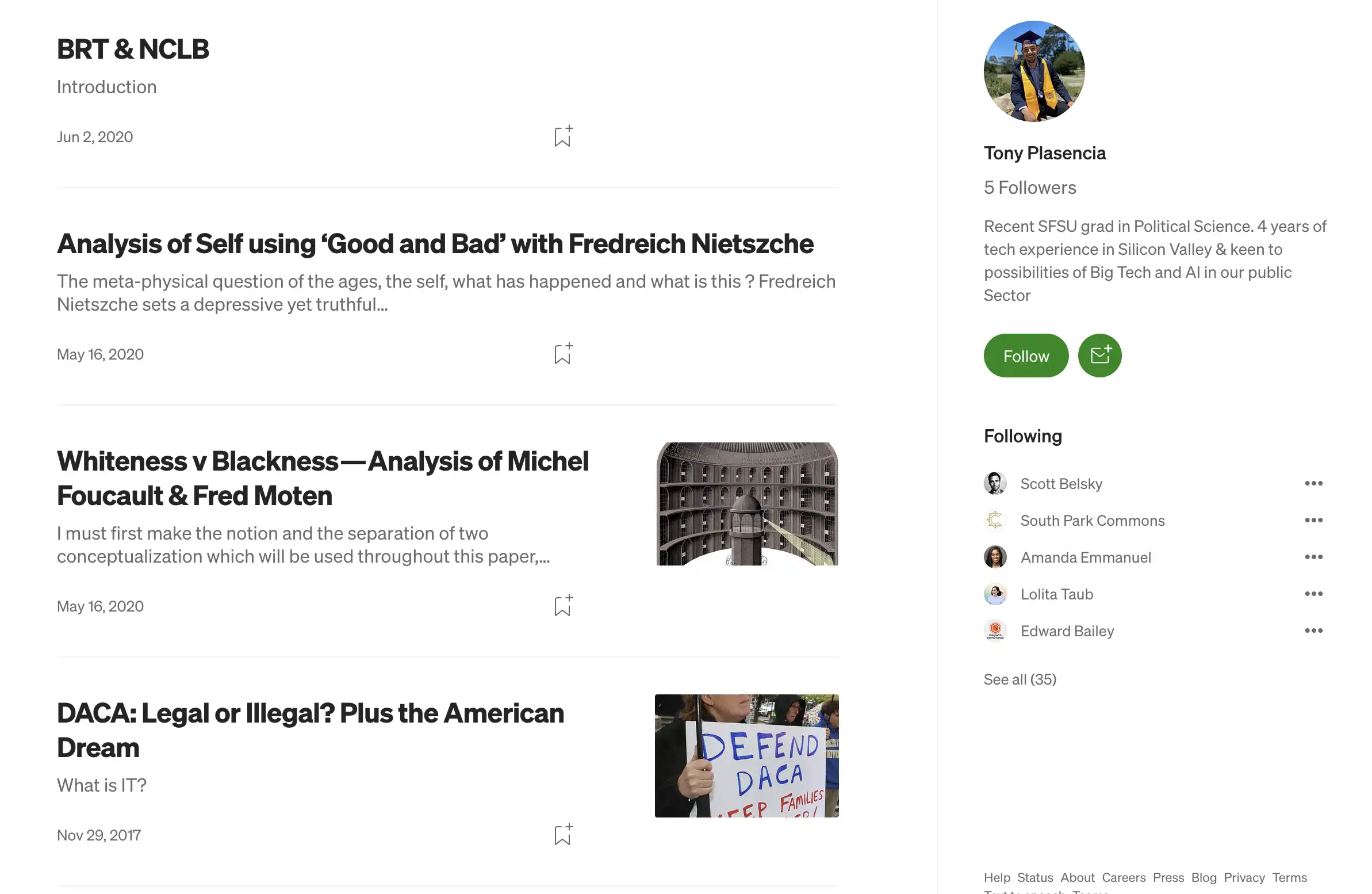
Unlike other cryptocurrency founders who often hide their personal information, you can easily find any information about him online. Even now, you can see his views on various social phenomena on Medium. After leaving Uber, he participated in and invested in many startups, including the famous VC-backed American household service website Thumbtack and the food ordering platform Ritual.
After many twists and turns, in 2022, he founded his first blockchain project (Underdog Protocol). Although it now appears to be a platform for no-code issuance of NFTs and SPL Tokens, the initial intention of the founding was to finance his future as a token, much like the Human Agent investment platform. Although this project did not cause a stir in the market, it was also his first foray into blockchain entrepreneurship.
His second stop was during the Blinks ecosystem boom, where he developed a platform to launch Blinks tokens and NFTs—Blinkdotfun. By locking the Sol used for buying and selling tokens in a Bonding Curve to reflect the token's market value fluctuations, users could share links on X, enabling others to directly buy or sell tokens on X, turning X into his launch platform.
And Griffain, released on November 1st this year, has become Tony's most successful Crypto project to date. He first introduced Griffain at the Hacking for Agentic Finance hackathon, with a vision to turn your ideas into actionable AI agents. Perhaps due to the accumulation of previous projects, Griffain quickly gained significant attention within the Solana ecosystem, with projects like Toly, vvAIfu, Jupiter, and Dialect expressing support or further collaboration to enhance the product.
The current stage of the CryptoAI project is developing rapidly, but it also faces significant differentiation. When discussing the AI Agent market, funding is primarily allocated to different areas: the upstream focuses on the architecture and ecosystem of AI agents or a hive system that allows agent aggregation, the midstream emphasizes AI agents with market influence, and the downstream focuses on AI apps with real application value or rapidly growing data set displays.
Griffain, as an all-in-one AI agent, covers the entire supply chain from upstream to downstream. Serving as an integrated AI app rather than a development framework, Griffain functions as a Perplexity-style AI agent directory. When a user makes a request, Griffain can summon an agent capable of fulfilling that request. This approach not only attracts attention to the AI agents launched on its platform but also bypasses the product and demand-side development extension step, directly connecting developers and users. This creates a kind of "SaaS" platform similar to an AI agent.
Just a few days ago, Griffain introduced the concept of SAIMP (Solana AI Message Protocol), which is akin to an on-chain communication system between AI agents. The exchangeable information includes sender/receiver addresses, topics, content, and more. Many experts or users believe that AI agents lack self-awareness and are merely algorithmic systems, making a communication system between them quite useless.
However, for the next cycle of AI agents, the ability to verify all data on-chain is crucial. The Tee architecture ensures that AI agents are not manipulated by humans but can act based on self-awareness. What SAIMP aims to achieve is to make communication between AI agents transparent or verifiable (like "private chats" between agents). More than functionality, storing and verifying information exchanged among multiple intelligent agents is a key feature.
It is also not difficult to imagine why the market has such high expectations for Griffain. Not only is it the first Web3 version of Perplexity, but more importantly, this platform provides an AI Agent with a platform for upstream and downstream interaction. Not only can it reduce the communication cost between AI Agents and humans, but functional transactions and communication between AI Agents can also be initiated by this AIpp Store. It is not only a human's App Store but also an AI's App Store.
It's All the Rage, Solana Also Has its Own 'Preferred Agent Kit'
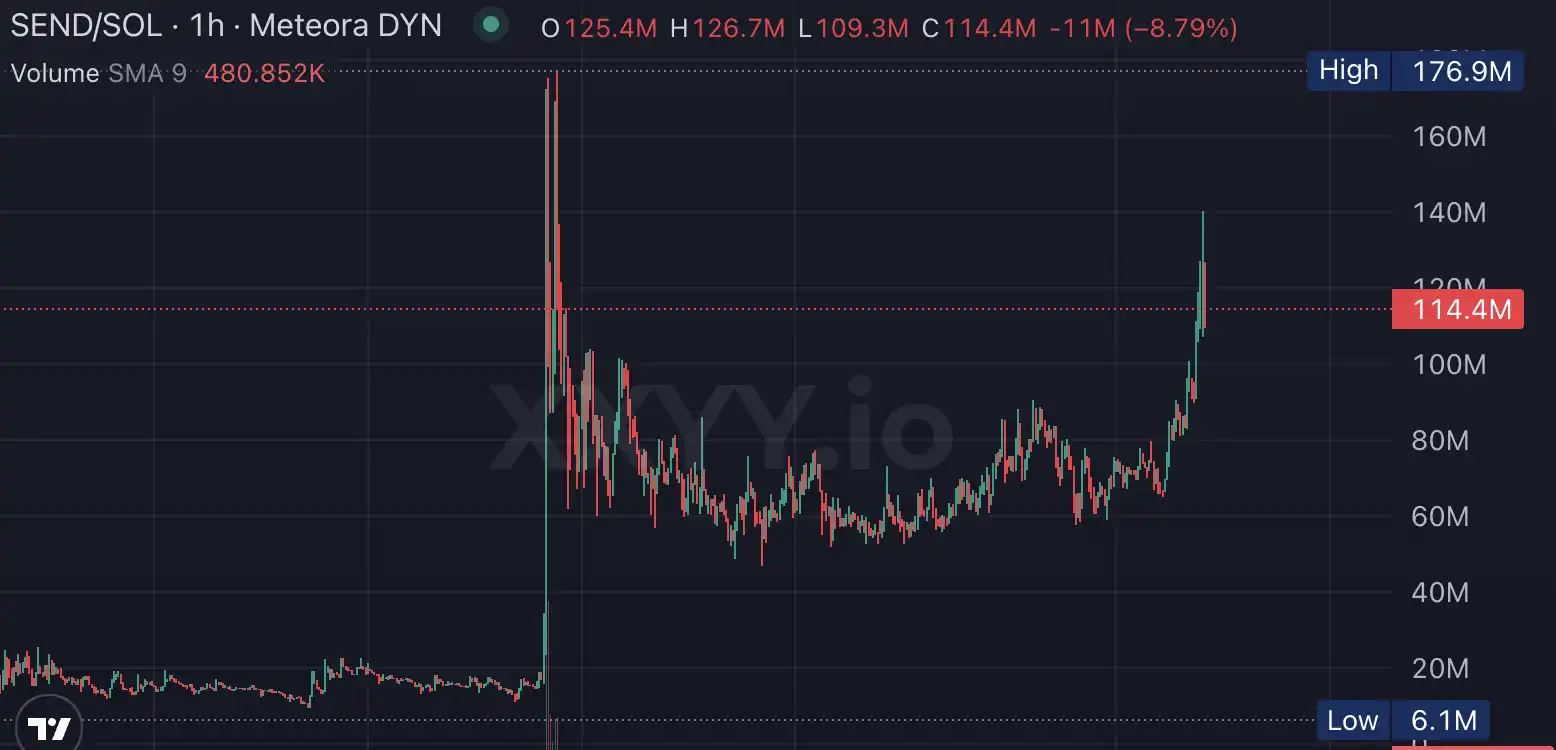
If we say that when Solana announced the hackathon hosted by SendAI, its token market value surged to $170 million, it was a reflection of the market's anticipatory mood. Today, Send's return to a $130 million market value is a true acknowledgment of the potential of its AI ecosystem.
Those familiar with Send know that when Solana introduced the Blinks concept, he almost replaced the official display of the use of 100 blinks on X, with two components making up Blinks, Actions and Blinks. Actions provide compliant APIs to quickly complete transfers, execute smart contracts, and other operations, while Blinks convert APIs into shareable links, allowing users to preview and trigger on-chain transactions directly on a webpage or social platform.
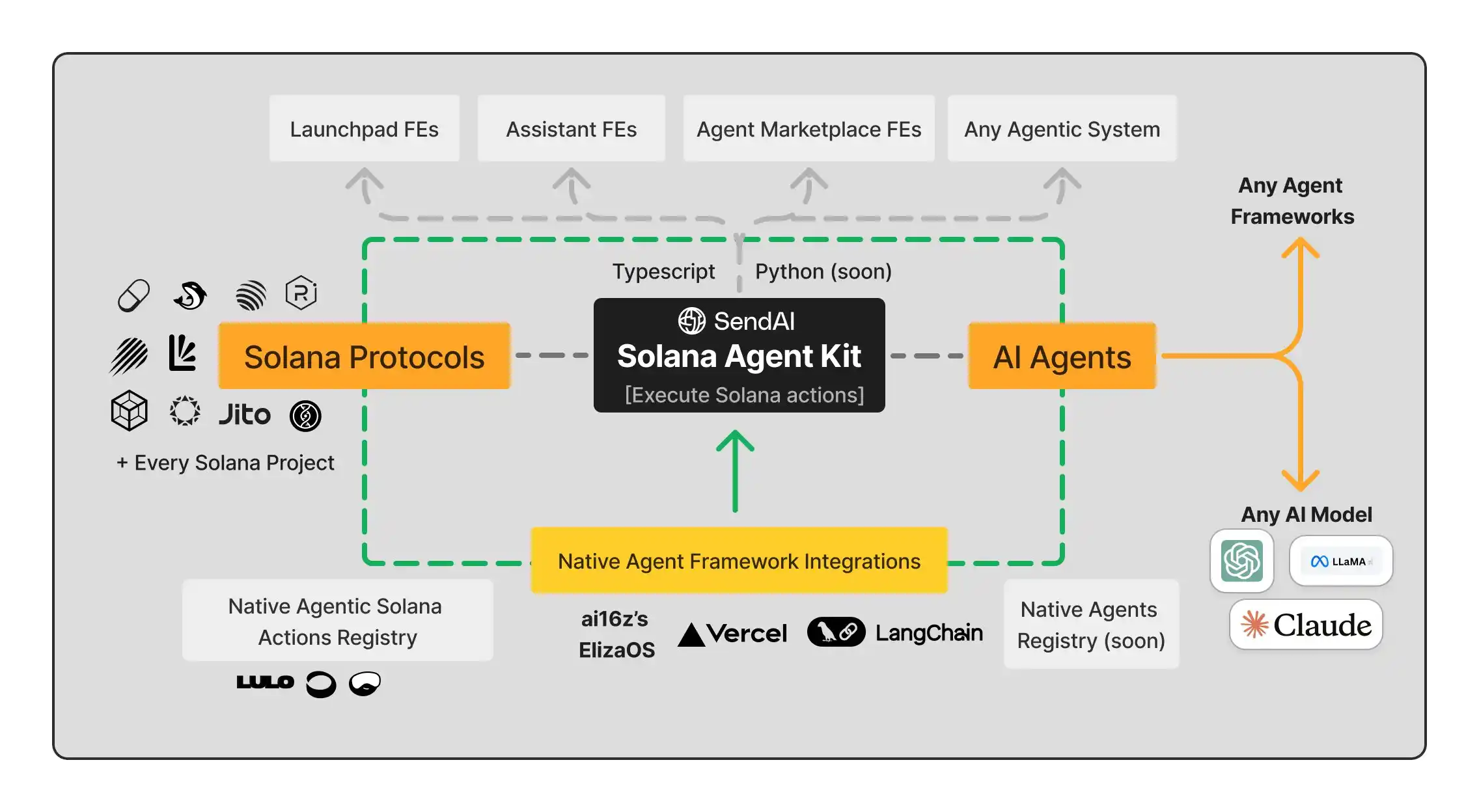
So, from a technical development standpoint, there is no more suitable team than the Send team, familiar with developing and applying blinks, to develop the infrastructure of the Solana AI Agent. With their rich on-chain interaction APIs and experience in making them interoperable with multi-web clients, their Agent kit not only supports a fusion of multiple language architectures but also supports multiple interaction modes embedding 'Dialect's blinks' and 'Send Arcade's games.' Agents using their tools can more easily interact with the blockchain or social media.
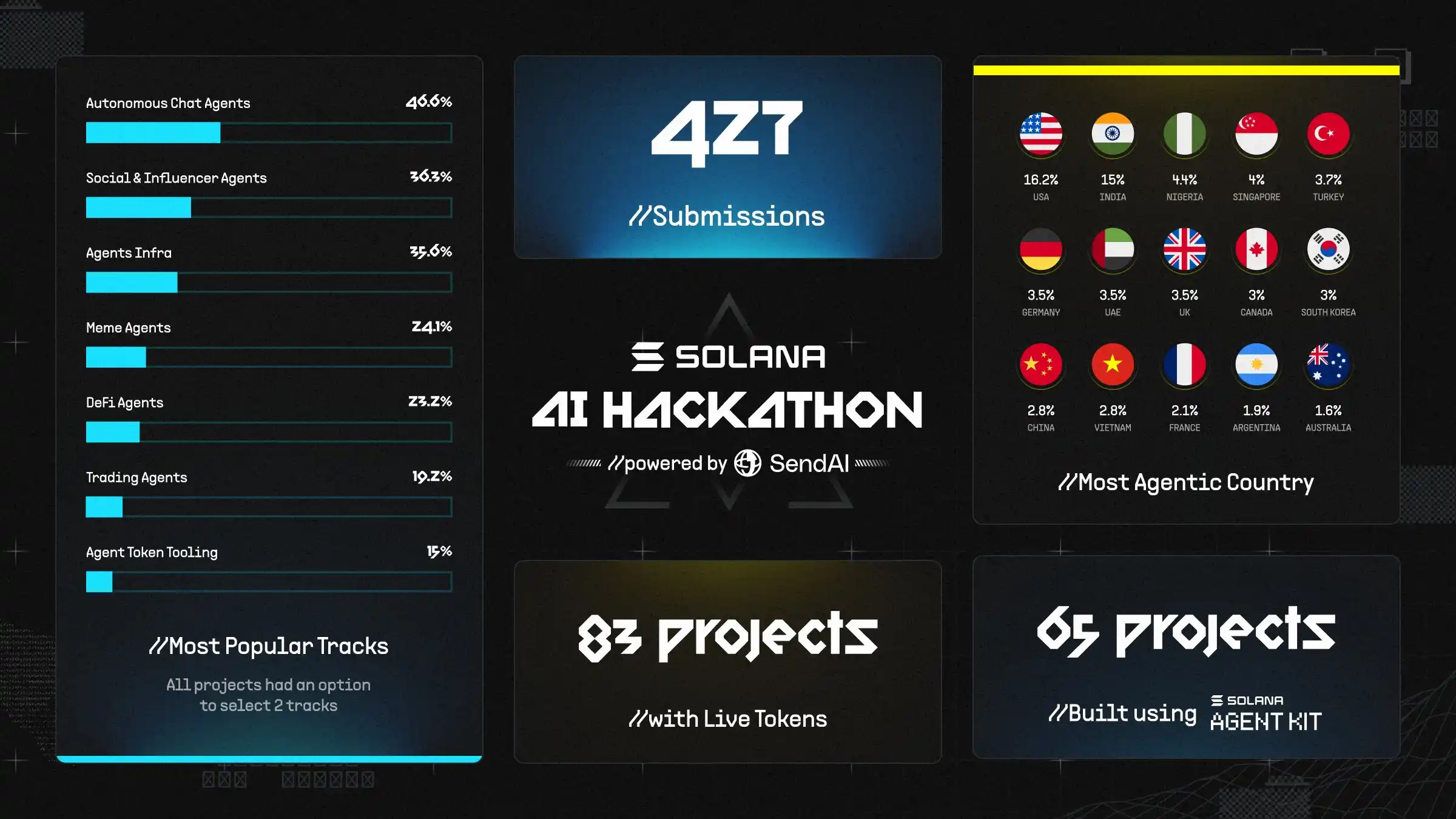
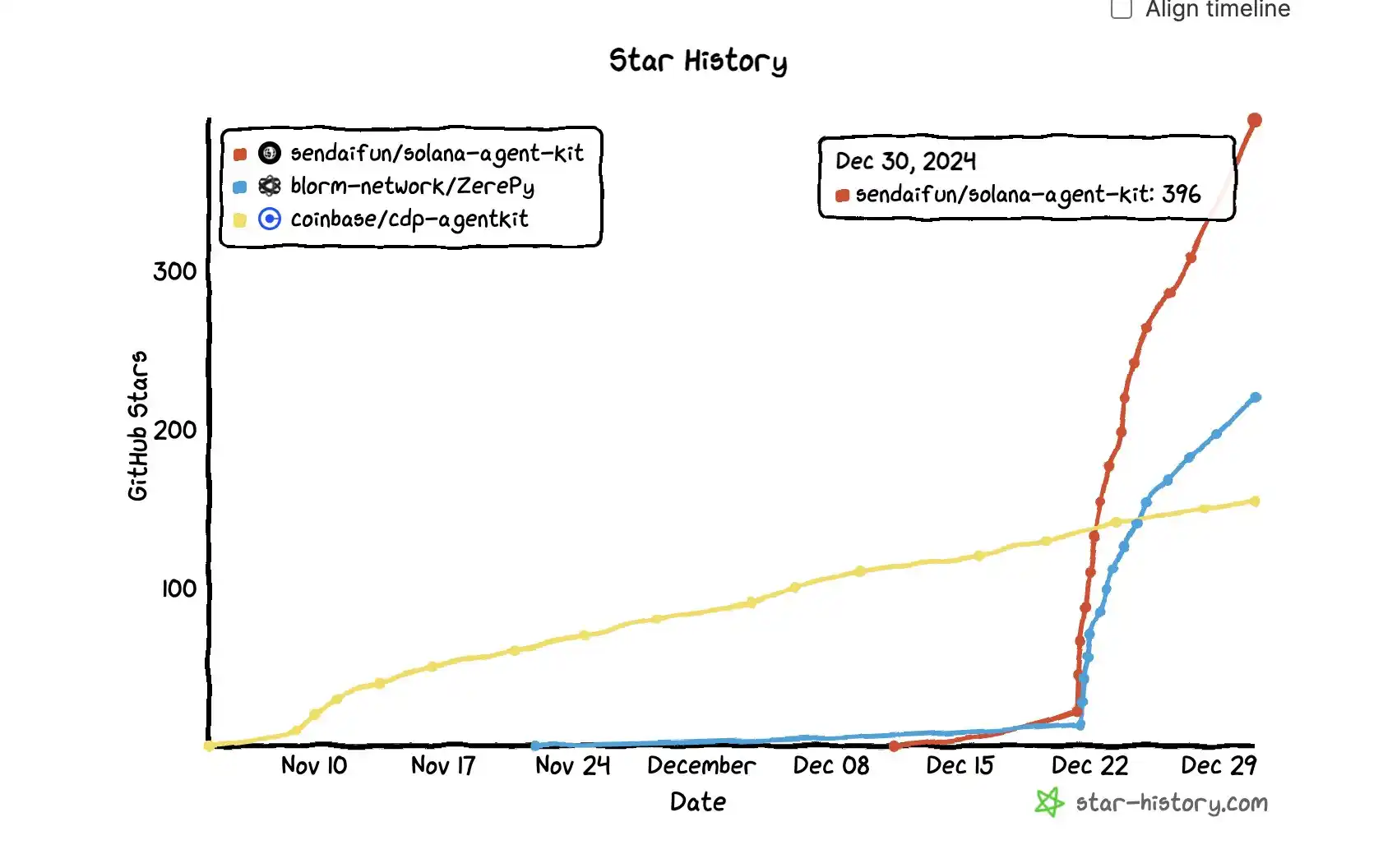
And the hackathon hosted by Send AI stopped accepting submissions a few days ago, with 427 projects successfully proposed in the end. In just a few weeks since the Solana Agent Kit was announced, there have been as many as 65 projects developed using the Solana Agent Kit. Furthermore, countless projects that did not participate in the competition but used this tool after the list closed, by the end of 2024, the star count of this open-source architecture had far exceeded Zerepy and Coinbase's CDP Agent Kit.
This is how the infrastructure of Solana, chosen for its high throughput and corresponding speed, has been prepared for various DePin projects to provide computing power and datasets, AI Agent basic tools such as Solana Agent Kit, Zerepy, ElizaOS, arc, etc., and all-in-one tools like griffain. AI Agent developers only need to unleash all their imagination to find possible use cases for users. With the infrastructure, the supply side, and the use case channels, a complete supply chain cycle is completed. This is Solana's strategy, and it will also be the most efficient way for Crypto AI to generate output.
You may also like

Concerns Behind the Binance Customer Service Controversy

Mergers and acquisitions in the cryptocurrency market are exceptionally active

SpaceX Stock Prediction After the IPO: Can SPCX Reach $200 Before QQQ Inclusion?

Congratulations to Carl Moon on His Historic Ferrari Challenge Le Mans Podium Triumph
Crypto influencer and racing enthusiast Carl Moon finished third in the Ferrari Challenge Le Mans Coppa Shell class, marking his best result of the year. As his racing partner and sponsor, WEEX celebrates this remarkable achievement and continues to lead crypto’s journey beyond boundaries, uniting the innovation of digital assets with the passion of motorsport.
A16Z: The sun bears witness, SpaceX is worth 7.5 trillion

The stablecoin positioning battle escalates: When compliance is just a ticket to entry, will USD1 become the biggest winner?

Can the CLARITY Act Become Law by July 4? Everything You Need to Know About the Final Battle

How to exit after asset tokenization?

The foundation of SpaceX's trillion-dollar valuation: Who is dividing Musk's annual capital expenditure of tens of billions?

France vs Senegal World Cup 2026: Mbappe’s New Era Begins Against a Historic Rival

SharpLink CEO: How to understand that Ethereum developers have just surpassed 1 million?

Morning Report | MiCA grace period expires on July 1; Kalshi's trading volume in the first week of the World Cup breaks $5.1 billion, setting a record

What is the connection between Huang Zheng of Pinduoduo and blockchain?

Morning Report | Prediction market platforms like Kalshi and Polymarket jointly sue Kentucky over 14.25% trading tax; Bridgewater founder discusses decision-making in the AI era: principled thinking should run parallel to AI, human insight remains irre...

If the AI bubble has already burst, who will truly remain?
Paul Graham: How to Make a Billion Dollars

After 18 years, blockchain has finally started to head towards the main channel
Claude enforces "facial recognition for household registration," starting in July, no ID card means no access?
Concerns Behind the Binance Customer Service Controversy
Mergers and acquisitions in the cryptocurrency market are exceptionally active
SpaceX Stock Prediction After the IPO: Can SPCX Reach $200 Before QQQ Inclusion?
Congratulations to Carl Moon on His Historic Ferrari Challenge Le Mans Podium Triumph
Crypto influencer and racing enthusiast Carl Moon finished third in the Ferrari Challenge Le Mans Coppa Shell class, marking his best result of the year. As his racing partner and sponsor, WEEX celebrates this remarkable achievement and continues to lead crypto’s journey beyond boundaries, uniting the innovation of digital assets with the passion of motorsport.
A16Z: The sun bears witness, SpaceX is worth 7.5 trillion
The stablecoin positioning battle escalates: When compliance is just a ticket to entry, will USD1 become the biggest winner?


